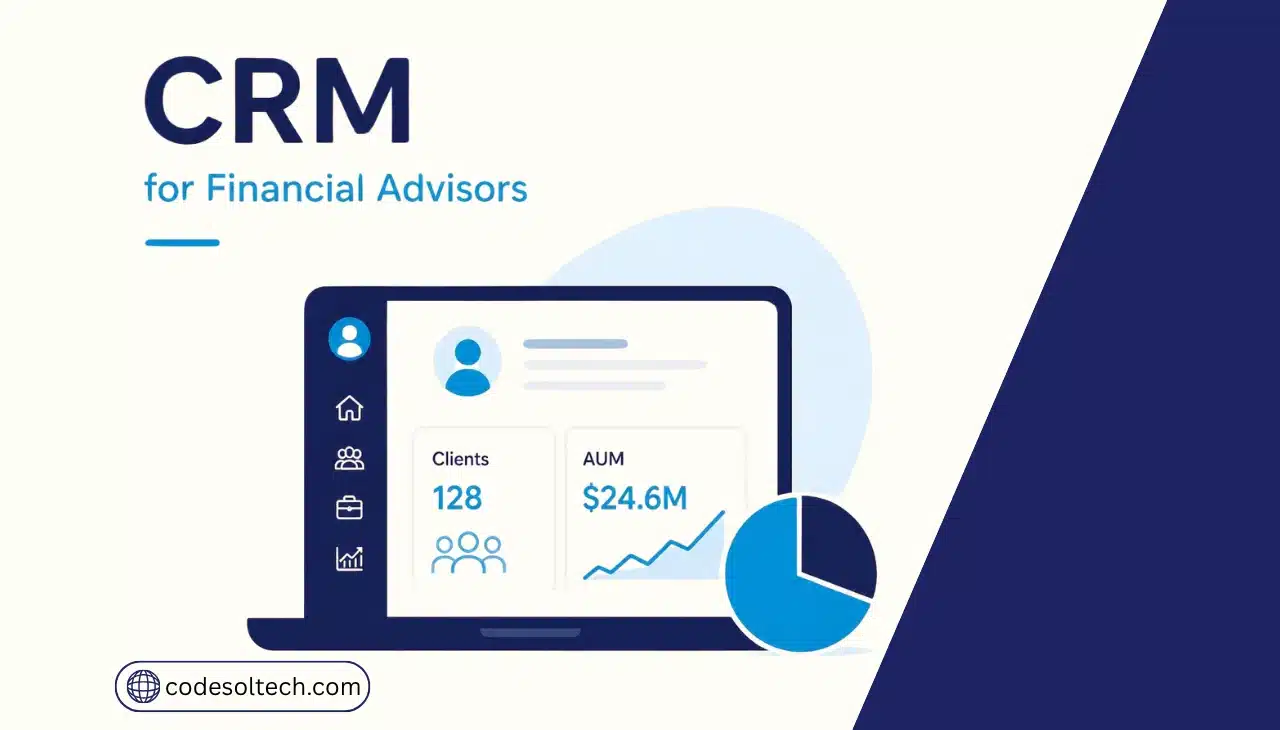
A CRM for financial advisors is software that centralizes client financial data, communication history, and compliance records in one system. It tracks life events, automates follow-ups, and flags recordkeeping requirements advisors must meet under SEC and FINRA rules. Advisory practices use this data to time outreach around client milestones, which directly supports retention.
Generic CRM platforms track leads and deals. A financial advisor CRM tracks households, not just individuals. It connects a client’s spouse, children, and eventual heirs to the same profile, because wealth transfer events move assets across that entire group.
- Household mapping: Links spouses, dependents, and heirs under one relationship record
- Compliance-ready storage: Retains communications in formats built to satisfy SEC Rule 17a-4
- Workflow automation: Triggers review meetings, rebalancing alerts, and document requests on a schedule
- Integration layer: Connects to custodians, financial planning software, and portfolio reporting tools
Why Does CRM Adoption Matter for Client Retention in Wealth Management
CRM adoption matters because advisor practices with structured client data retain more assets over time, and retention drives firm valuation.
Charles Schwab’s 2025 RIA Benchmarking Study, based on 1,288 participating firms managing a combined $2.4 trillion in assets, found that client retention among RIAs has held at 97 percent for the past decade. That stability does not happen by accident.

The firm’s earlier 2023 RIA Benchmarking Study identifies referrals as the leading growth channel. Referrals from clients and business partners accounted for 70 percent of new clients and 69 percent of new client assets. Yet, only 34 percent of firms had a documented client referral plan, and 25 percent had a documented business partner referral plan.
A CRM closes that gap by logging referral sources, triggering thank-you workflows, and surfacing which clients have not been asked for a referral in the current quarter.
Asset size also predicts retention risk. Research published by McKinsey using PriceMetrix data found that a household with $100,000 in assets has a retention probability of 0.87 in any given year. In contrast, a household with $500,000 in assets has a retention probability of 0.94.
Smaller accounts churn faster. A CRM flags these accounts for proactive outreach before they become an attrition statistic, instead of after.
What Core Features Does a Financial Advisor CRM Need
A financial advisor CRM needs six core capabilities: household-level data structure, workflow automation, compliance archiving, integration with planning software, segmentation tools, and reporting dashboards. Each feature maps to a specific retention or compliance risk.
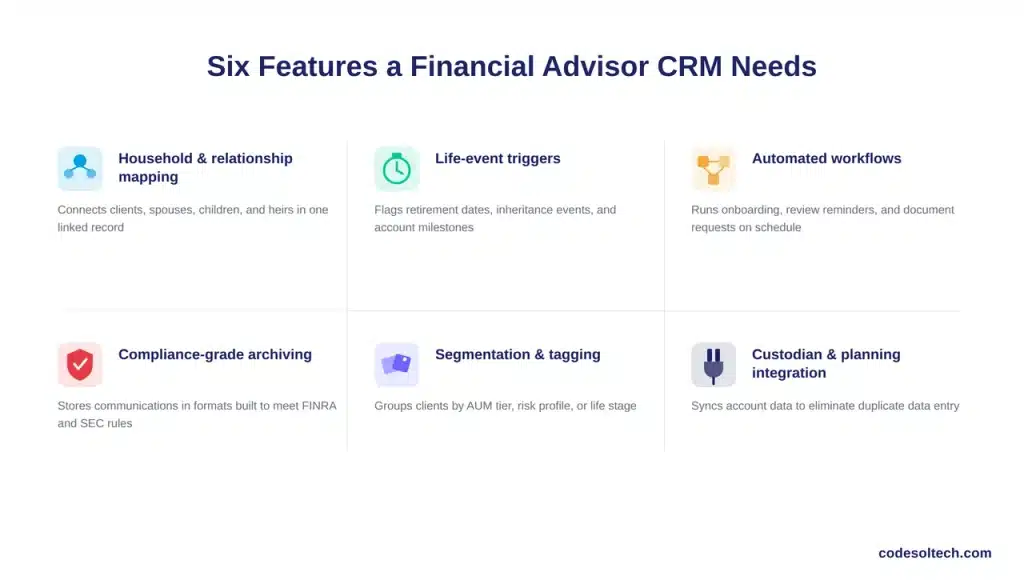
- Household and relationship mapping: Connects primary clients to spouses, children, and named heirs in one linked record
- Life-event triggers: Flags retirement dates, inheritance events, and account milestones for scheduled outreach
- Automated workflows: Runs onboarding sequences, annual review reminders, and document collection tasks without manual tracking
- Compliance-grade archiving: Stores emails, texts, and notes in a format built to satisfy FINRA and SEC recordkeeping rules
- Segmentation and tagging: Groups clients by AUM tier, risk profile, or life stage for targeted communication
- Custodian and planning software integration: Syncs account data with custodial platforms and financial planning tools to eliminate duplicate entry
Adoption of this technology is already near-universal among independent advisors. Industry survey data collected by the T3/Inside Information Software Survey, summarized on Kitces.com, puts CRM usage among financial advisors at approximately 92 percent.
Separately, Cerulli Associates research found that advisors rank CRM as the second-most-cited technology for improving operational efficiency, with 44 percent of advisors crediting it directly, behind only e-signature tools at 65 percent.
CRM is now a baseline operating requirement, not a differentiator on its own.
How Does a CRM Support Compliance and Recordkeeping for Advisors
A CRM supports compliance by capturing client communications in a searchable, retrievable format that regulators can request during an examination.
Under FINRA’s books and records rules, a broker-dealer must retain originals of all business communications received and copies of all communications sent for at least three years, with the first two years kept in an easily accessible place.
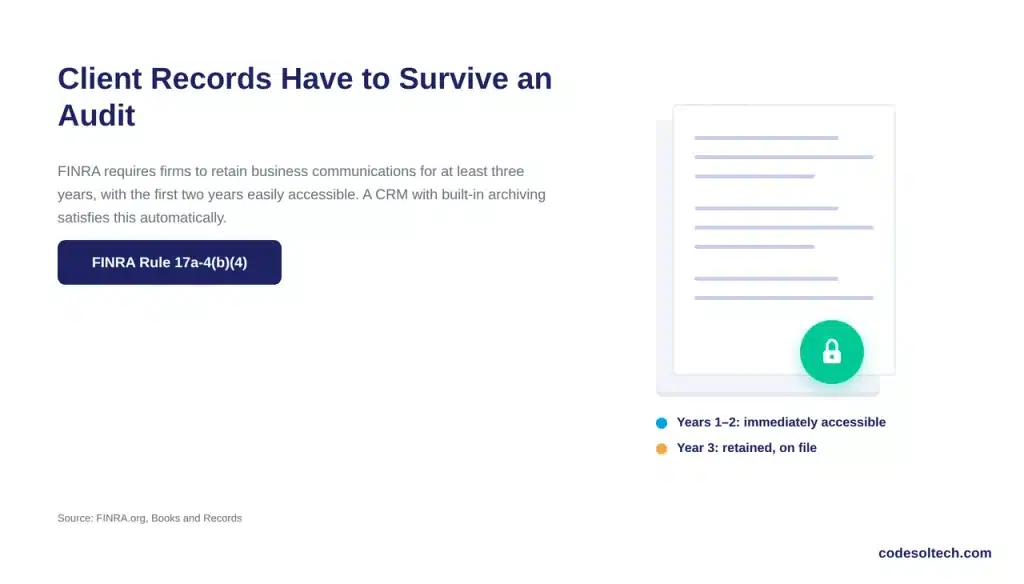
A CRM with built-in archiving satisfies this requirement automatically, instead of relying on an advisor to manually log every email and call note.
This matters operationally. Off-channel communication, meaning business messages sent through personal texting apps outside a firm’s approved system, is a recurring enforcement focus for the SEC and FINRA. A CRM that logs calls, emails, and meeting notes inside one auditable system reduces this exposure directly.
How Does CRM Data Build Long-Term Client Relationships
CRM data builds long-term relationships by giving advisors a documented reason to reach out before the client initiates contact. A system that logs a client’s upcoming retirement date, a recent inheritance, or a child starting college prompts a relevant, timely conversation instead of a generic quarterly check-in.
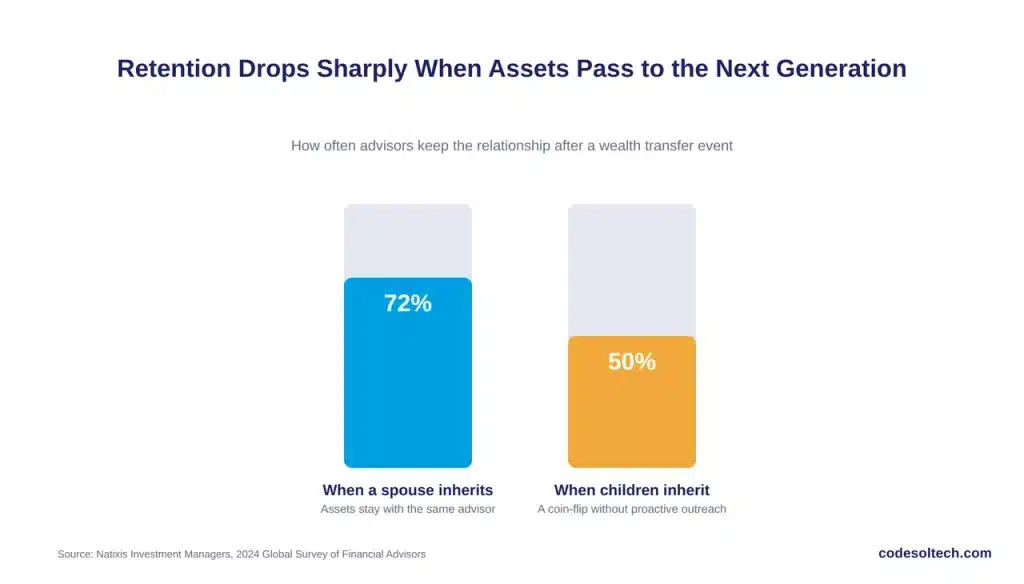
Wealth transfer planning is a specific area where CRM tracking reduces retention risk. Natixis Investment Managers’ 2024 Global Survey of Financial Advisors found that 43 percent of advisors worldwide are increasingly worried about retaining assets from client spouses or heirs, and 52 percent stress the importance of building relationships with those heirs before a wealth transfer occurs.
The same survey found advisors retain client relationships 72 percent of the time when a spouse inherits, but only about half the time when children inherit.
A CRM that stores heir contact details and schedules them into review meetings years ahead of an inheritance event directly addresses this gap.
- Segmented communication: Sends relevant content by life stage instead of one generic newsletter to every client
- Next-generation engagement: Tracks and schedules outreach to adult children and heirs before a wealth transfer event
- Service consistency: Ensures every team member sees the same client history, so service quality does not depend on one advisor’s memory
- Proactive review scheduling: Automates annual and life-event-triggered review meetings instead of relying on the client to request one
How Should an Advisory Firm Choose the Right CRM
An advisory firm should choose a CRM by matching system capability to three factors: firm size, custodian relationships, and compliance obligations.
A solo RIA managing under $100 million in assets has different integration needs than a hybrid broker-dealer team managing multiple custodians.

- Audit the current tech stack: List every custodian, planning tool, and portfolio system that must connect to the CRM
- Confirm compliance archiving: Verify the vendor supports storage built for SEC Rule 17a-4 before signing a contract
- Test household mapping: Confirm the system links family members and heirs, not just individual contact records
- Evaluate automation depth: Check whether the platform runs multi-step workflows or only sends single reminder emails
- Plan for custom development: Off-the-shelf platforms rarely fit multi-custodian or multi-entity RIA structures without configuration work
Firms operating across multiple custodians or with non-standard workflows often need custom CRM development rather than a rigid off-the-shelf platform.
A development partner can build direct CRM integration with existing custodial and planning systems, structure workflow automation around firm-specific compliance steps, and design the system through custom CRM development when standard platforms cannot support the firm’s structure.
FAQs
Do financial advisors actually need a CRM, or is a spreadsheet enough?
A spreadsheet tracks contact details. It does not automate compliance archiving, trigger life-event outreach, or scale past a handful of clients without manual errors. Once a practice manages more than a few dozen households, a spreadsheet cannot maintain the audit trail regulators require or the outreach cadence retention depends on.
How does CRM data affect client retention specifically?
CRM data affects retention by making outreach timely instead of generic. Advisors who log life events and referral sources reach out at the right moment, which the data above ties directly to higher retention among firms with structured referral tracking.
Is CRM data covered by SEC and FINRA recordkeeping rules?
Yes. Client communications stored in a CRM, including emails, texts synced into the system, and meeting notes tied to a client record, fall under the same retention rules that apply to any other business communication.
Can a generic CRM like a sales platform work for a financial advisory practice?
A generic sales CRM tracks deals and pipelines, not households, compliance archiving, or life-event triggers. It can work for very small practices with minimal compliance exposure, but it typically requires custom configuration to meet wealth management recordkeeping and household-mapping needs.
Final Words
CRM adoption among financial advisors is near-universal for a reason: retention is the industry’s core economic driver, and retention depends on documented, timely client contact. The firms holding steady at 97 percent retention are not relying on memory. They are running structured systems.
If your practice is outgrowing a generic CRM or a spreadsheet, talk to CodeSol Technologies about building a CRM system matched to your custodians, your compliance obligations, and your household structure.