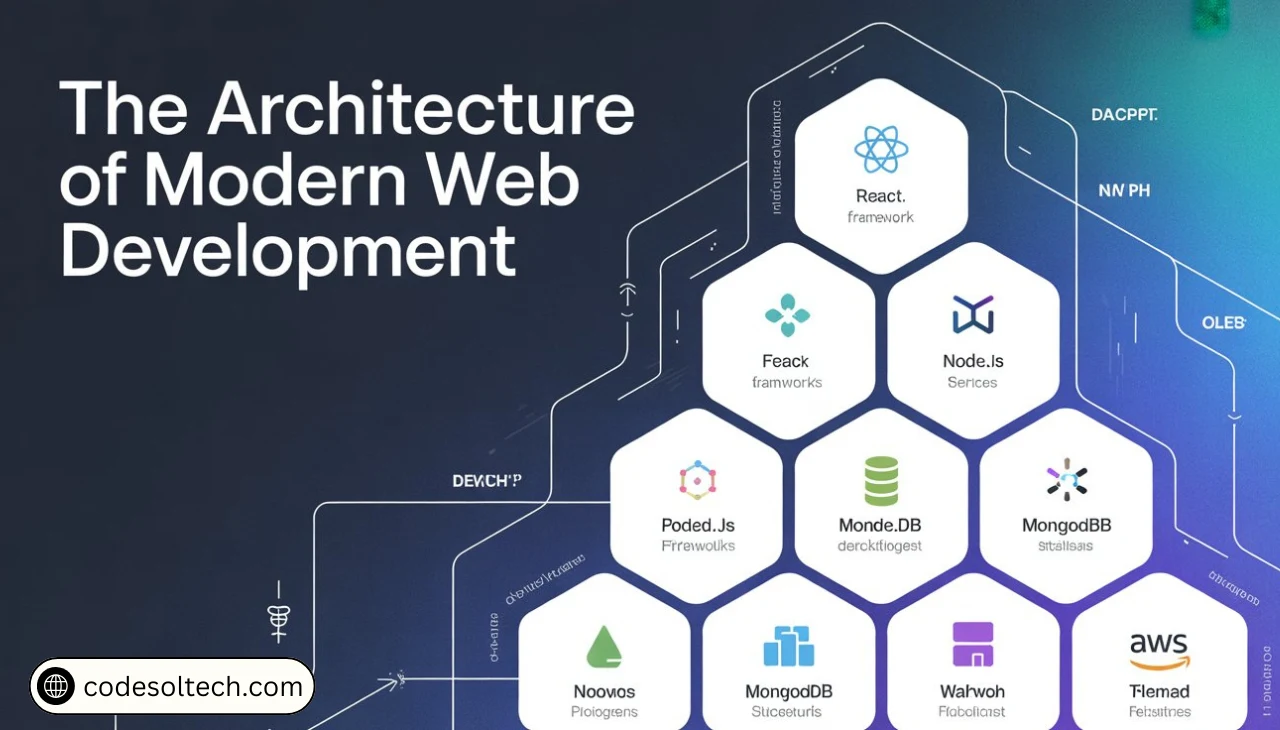
Modern web architecture defines the structural relationship between the server, the network layer, the browser, and the JavaScript runtime that together produce a rendered web document. The 4 primary rendering paradigms in current production environments are: Server-Side Rendering (SSR), Client-Side Rendering (CSR), Static Site Generation (SSG), and Incremental Static Regeneration (ISR).
Each paradigm determines where and when HTML is generated, which directly governs three measurable outcomes: Time to First Byte (TTFB), First Contentful Paint (FCP), and Googlebot’s ability to index page content during a single crawl cycle.
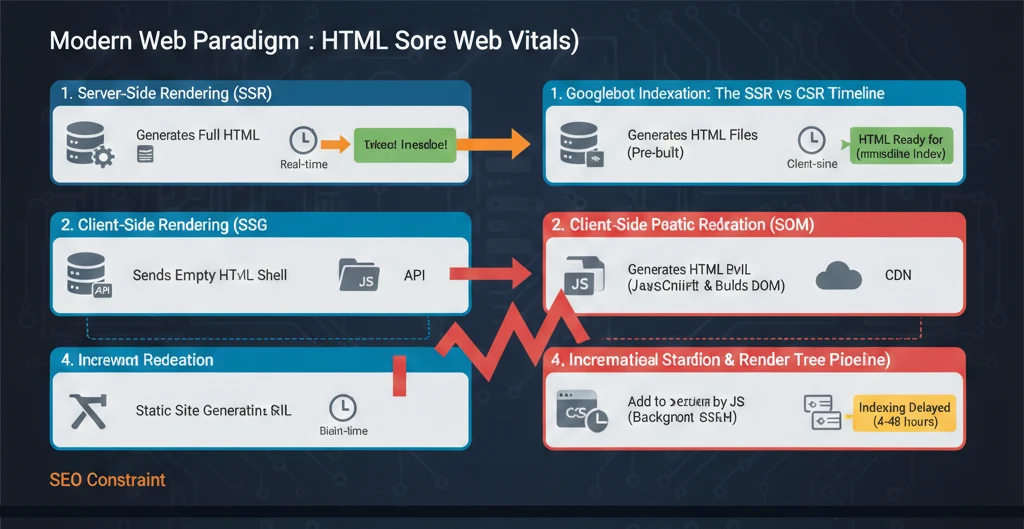
The Document Object Model (DOM) is the in-memory, tree-structured representation of an HTML document that the browser constructs upon receiving an HTML byte stream. All rendering paradigms produce an HTML document, but they differ in whether that document arrives fully formed from the server or is assembled in the browser by a JavaScript engine.
2. Server-Side Rendering (SSR): Technical Definition and SEO Mechanics
How SSR Executes
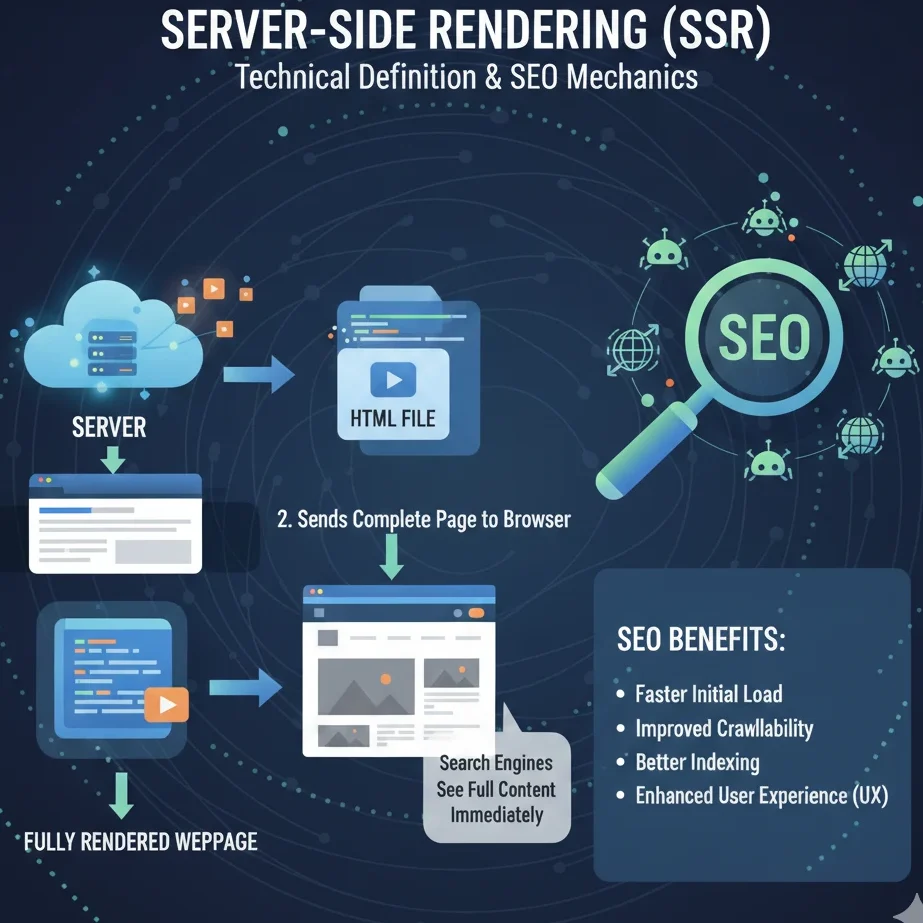
Server-Side Rendering (SSR) is the process in which a web server generates a complete HTML document on each incoming HTTP request and transmits it to the client before any JavaScript executes in the browser. The server resolves data dependencies, executes templating or component logic, and serializes the result into a static HTML string.
The browser receives a fully-formed HTML payload. This reduces Time to First Byte (TTFB) variance because the critical rendering path does not depend on client-side JavaScript execution. Googlebot renders SSR pages in a single fetch cycle without requiring a secondary JavaScript rendering queue.
Key Fact
SSR reduces Googlebot’s dependency on deferred JavaScript rendering. Pages with SSR are indexed in the first crawl wave; CSR pages enter a secondary rendering queue that delays indexation by hours to days.
SSR Performance Metrics
| Metric | SSR Behavior | SEO Impact |
|---|---|---|
| TTFB | Variable; scales with server compute time | Negative if unoptimized — target < 200ms |
| FCP | Fast — HTML is pre-rendered on the server | Positive; content is visible to crawler immediately |
| LCP | Determined by server-rendered above-the-fold content | Positive; LCP element exists in initial HTML payload |
| JavaScript Dependency | None required for initial content delivery | Positive; Googlebot indexes content without JS execution |
| Crawl Budget | 1 request = 1 fully indexed page | Efficient; no secondary rendering queue consumption |
SSR Execution Environments
SSR executes in 3 primary environments in modern stacks:
- Node.js runtime (Next.js, Nuxt.js, Remix): The application server executes React or Vue component trees server-side and returns serialized HTML.
- Edge runtime (Vercel Edge Functions, Cloudflare Workers): SSR executes at CDN edge nodes, reducing geographic latency between server and client.
- Lambda / serverless functions (AWS Lambda, Google Cloud Functions): SSR executes on-demand without persistent server processes, scaling horizontally by invocation.
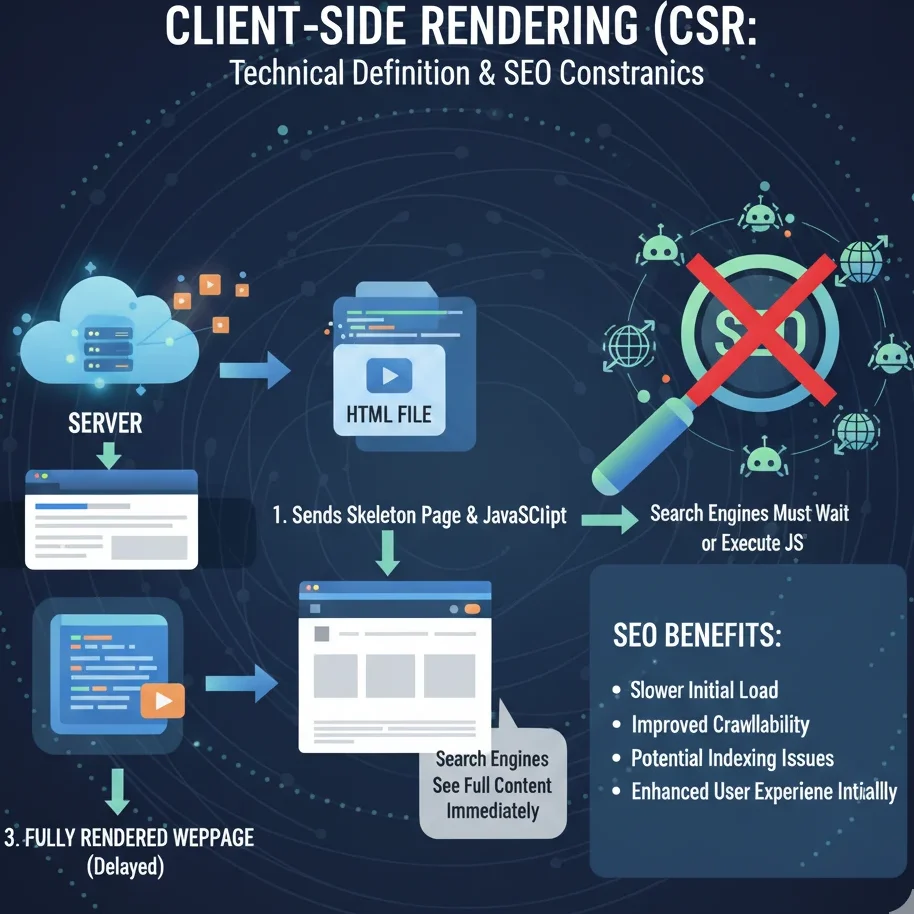
3. Client-Side Rendering (CSR): Technical Definition and SEO Constraints
How CSR Executes
Client-Side Rendering (CSR) is the process in which the server delivers a minimal HTML shell — typically a single <div id="root"> element — and delegates all DOM construction to JavaScript executing in the browser. The JavaScript bundle fetches data via asynchronous API calls and builds the DOM at runtime.
The browser performs 3 sequential operations before content is visible: (1) parse the HTML shell, (2) download and parse the JavaScript bundle, (3) execute the JavaScript to construct the DOM. This sequence produces a measurable FCP delay relative to SSR, because no meaningful content exists in the initial HTML payload.
Googlebot processes CSR pages through a secondary rendering queue. This queue introduces an indexation delay of 4 to 48 hours between the initial crawl and the indexation of JavaScript-rendered content. Pages that rely exclusively on CSR for critical content risk delayed or incomplete indexation.
SEO Constraint
CSR pages with content embedded exclusively in JavaScript bundles require Googlebot’s secondary rendering queue. This delay directly reduces the speed at which new or updated content enters Google’s index.
CSR Architectural Components
A CSR architecture consists of 4 interdependent components:
- HTML Shell: A static, minimal HTML document containing the JavaScript bundle reference and a single root mounting element.
- JavaScript Bundle: The compiled application code (React, Vue, Angular, Svelte) that constructs and manages the DOM at runtime.
- API Layer: A set of RESTful or GraphQL endpoints that the JavaScript bundle queries asynchronously to retrieve page data.
- Browser JavaScript Engine (V8, SpiderMonkey): The runtime environment that parses, compiles, and executes the application bundle.
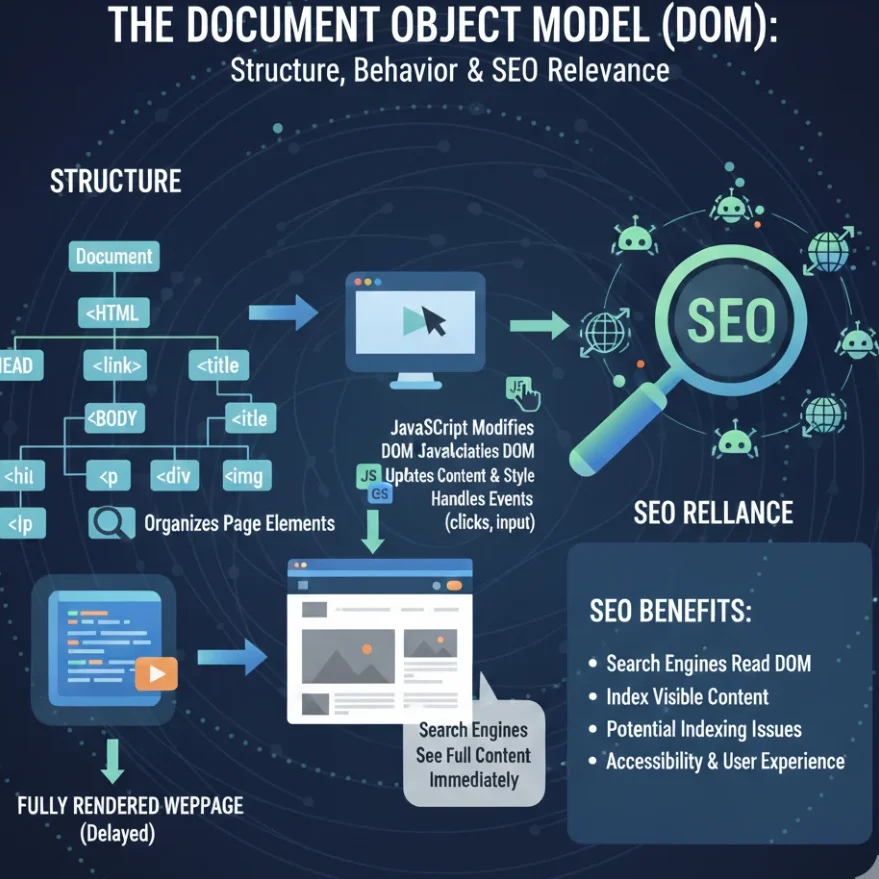
4. The Document Object Model (DOM): Structure, Behavior, and SEO Relevance
DOM Architecture
The Document Object Model (DOM) is a language-agnostic, hierarchical API that represents an HTML or XML document as a tree of node objects. The W3C DOM specification defines 12 node types; the 4 operationally significant types in web development are: Element nodes, Text nodes, Attribute nodes, and Document nodes.
The DOM tree root is the Document node. The Document node contains a single child: the <html> Element node. The <html> node branches into 2 child nodes: <head> and <body>. All visible page content resides within the <body> subtree.
DOM Construction Process
The browser constructs the DOM through 5 sequential steps:
- Byte Stream Receipt: The browser receives the HTML byte stream from the server over HTTP/2 or HTTP/3.
- Tokenization: The HTML parser converts the byte stream into discrete tokens — start tags, end tags, attribute tokens, and text tokens.
- Node Creation: The parser creates DOM node objects from each token.
- Tree Construction: The parser inserts nodes into the DOM tree in document order, resolving parent-child relationships.
- CSSOM Merge: The browser merges the DOM tree with the CSS Object Model (CSSOM) to produce the Render Tree, which drives layout and painting.
Crawl Note
Googlebot reads the DOM state post-JavaScript execution. Content that exists only in the JavaScript bundle and is appended to the DOM after load is subject to secondary rendering queue delays. Content present in the initial HTML payload is indexed immediately.
DOM vs. Virtual DOM
The Virtual DOM (VDOM) is an in-memory JavaScript object that mirrors the structure of the real DOM. React, Vue 2, and Inferno maintain a Virtual DOM to batch and optimize DOM mutations. The VDOM diffing algorithm — reconciliation — computes the minimal set of real DOM mutations required to reflect a state change, reducing browser reflow and repaint operations.
| DOM Type | Technical Definition |
|---|---|
| Real DOM | The browser’s live, mutable object representation of the HTML document. Direct manipulation triggers synchronous reflow. |
| Virtual DOM | An in-memory JavaScript object tree. React uses VDOM reconciliation to batch and minimize real DOM mutations. |
| Shadow DOM | A scoped DOM tree encapsulated within a Web Component. Shadow DOM styles and structure are isolated from the main document DOM. |
| Incremental DOM | Angular Ivy’s architecture compiles templates into DOM instructions that update the real DOM in-place, without a full VDOM copy. |
5. Hydration: Definition, Mechanics, and Performance Implications
What Hydration Executes
Hydration is the process in which a client-side JavaScript framework attaches event listeners and component state to a server-rendered static HTML document. Hydration transforms a static HTML string — delivered by SSR — into an interactive, JavaScript-controlled application.
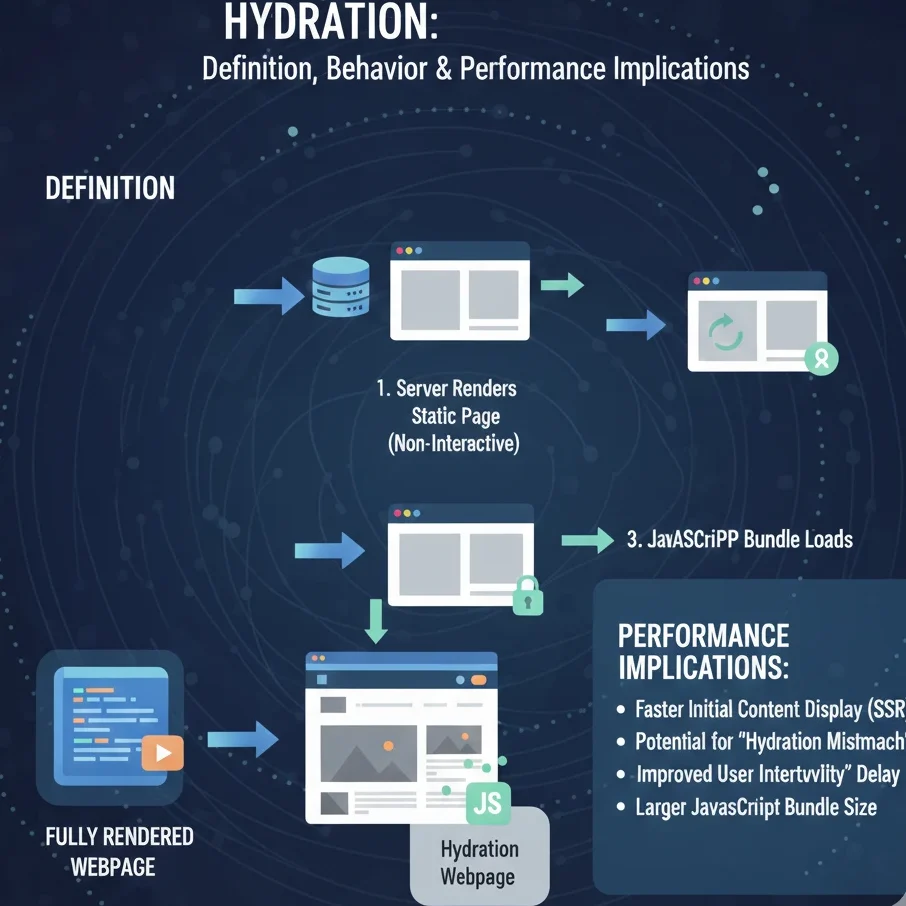
The hydration sequence executes in 3 phases:
1- The browser parses and displays the SSR HTML, making content immediately visible.
2- The JavaScript bundle downloads and parses.
3- The framework reconciles the server-rendered DOM with the client-side component tree and attaches event listeners to existing DOM nodes without rebuilding the DOM from scratch.
Hydration is the architectural bridge between SSR’s SEO advantage fully-rendered HTML for Googlebot and the application requirement for JavaScript-driven interactivity. Without hydration, SSR pages remain static and cannot respond to user interactions managed by JavaScript frameworks.
Performance
The interval between the browser displaying SSR-rendered content (FCP) and hydration completing is called Time to Interactive (TTI). During this window, the page is visually complete but non-interactive. Long hydration times directly increase TTI, which Core Web Vitals measure as Interaction to Next Paint (INP).
Hydration Variants
Modern frameworks implement 4 hydration strategies to minimize TTI and JavaScript payload size:
- Full Hydration: The framework hydrates the entire component tree on page load. React 17 and Vue 2 implement full hydration by default.
- Partial Hydration: Only interactive components receive JavaScript event listeners. Static content regions are never hydrated. Astro’s Islands Architecture implements partial hydration.
- Progressive Hydration: Components hydrate sequentially based on viewport visibility or user interaction triggers, rather than all-at-once on page load.
- Resumability (Qwik): The server serializes full application state and event listeners into the HTML payload. The browser resumes execution from the serialized checkpoint without re-executing framework bootstrap code, eliminating the traditional hydration cost entirely.
Hydration Mismatch Errors
Hydration mismatch occurs when the DOM structure produced by SSR differs from the DOM structure the client-side framework expects to find during reconciliation. React logs a hydration mismatch as a console error and falls back to full client-side re-rendering of the affected component subtree.
Hydration mismatches arise from 3 sources: (1) Non-deterministic data between server and client renders — such as timestamps or random IDs. (2) Browser-injected markup — such as extensions modifying the DOM before hydration. (3) Conditional rendering logic that evaluates differently in Node.js versus browser environments.
6. Architectural Comparison: SSR, CSR, SSG, and ISR
| Paradigm | HTML Source | Data Freshness | TTFB | Googlebot Indexation | Interactivity |
|---|---|---|---|---|---|
| SSR | Server on each request | Real-time | Variable (server compute) | Immediate — 1st crawl wave | Hydration post-load |
| CSR | Browser at runtime | Real-time via API | Fast (static shell) | Delayed — 2nd render queue | Native JS; no hydration |
| SSG | Build-time pre-render | Build-time snapshot | Fast (CDN-served) | Immediate — 1st crawl wave | Hydration post-load |
| ISR | Stale-while-revalidate | Configurable TTL | Fast (cached) | Immediate (cached version) | Hydration post-load |
7. Crawl Budget, Googlebot, and Rendering Architecture
How Rendering Architecture Consumes Crawl Budget
Crawl budget is the number of URLs Googlebot fetches and renders from a domain within a defined time window. Google allocates crawl budget based on 2 factors: crawl rate limit (the server’s capacity to handle Googlebot requests) and crawl demand (the popularity and freshness of URLs).
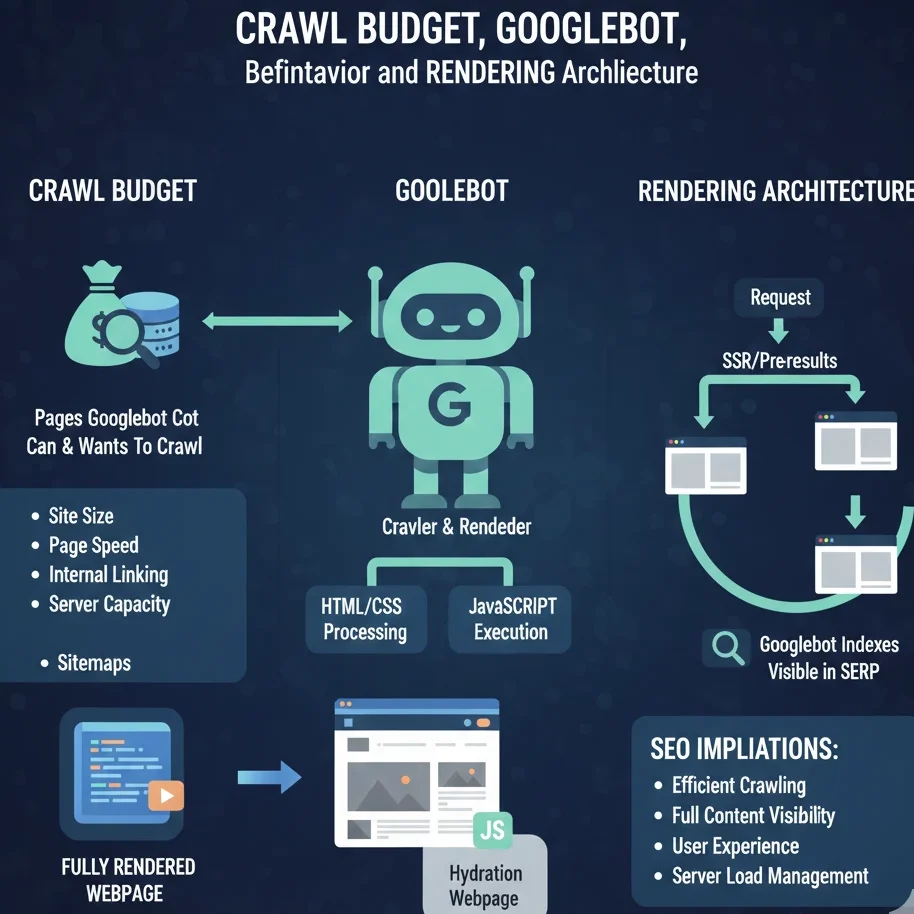
CSR architectures consume crawl budget through 2 mechanisms: (1) The initial HTML shell fetch, which delivers no indexable content. (2) The secondary JavaScript rendering, which consumes additional crawl budget allocation for the same URL. SSR and SSG architectures consume crawl budget through a single fetch, because the HTML payload in the first request contains all indexable content.
Googlebot’s JavaScript Rendering Service (WRS)
Google’s Web Rendering Service (WRS) is a headless Chromium-based browser that Googlebot uses to execute JavaScript and build the post-execution DOM state of web pages. WRS operates on a queued basis; JavaScript rendering is not simultaneous with the initial crawl. This queue introduces additional latency for CSR content indexation.
WRS executes JavaScript in a constrained environment with 3 documented limitations:
- No persistent session state: Authentication-gated content is not rendered.
- Resource loading timeout: JavaScript bundles exceeding WRS timeout limits are only partially executed.
- No cross-origin resource inheritance: Third-party JavaScript requiring authenticated cross-origin requests fails silently inside WRS.
8. Framework-to-Architecture Mapping
| Framework | Default Paradigm | SSR Support | Partial Hydration | Resumability |
|---|---|---|---|---|
| Next.js (React) | SSR / SSG hybrid | Yes (App Router) | No — full hydration | No |
| Nuxt.js (Vue) | SSR / SSG hybrid | Yes | No — full hydration | No |
| Remix (React) | SSR | Yes (primary model) | No | No |
| Astro | SSG with Islands | Yes (server islands) | Yes — Islands Architecture | No |
| Qwik | SSR | Yes | Yes (automatic) | Yes (native) |
9. Core Web Vitals and Rendering Architecture
Google’s Core Web Vitals assessment measures 3 metrics that rendering architecture directly controls:
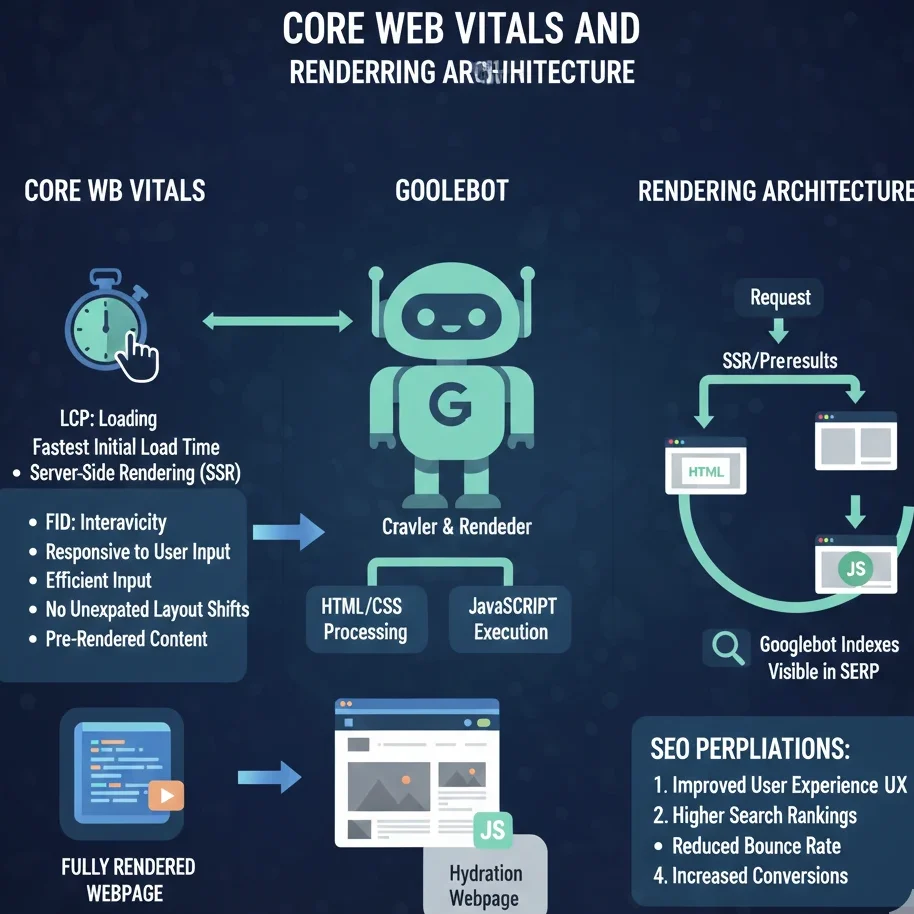
Largest Contentful Paint (LCP)
Measures the render time of the largest visible content element. SSR and SSG architectures deliver LCP elements in the initial HTML payload, producing LCP values below the 2.5-second threshold. CSR architectures defer LCP element rendering until JavaScript execution completes, frequently exceeding this threshold.
Cumulative Layout Shift (CLS)
Measures visual stability. CSR architectures that inject content asynchronously after initial paint produce layout shifts as DOM elements reflow around late-loading content. SSR architectures with pre-defined element dimensions produce CLS scores of 0.
Interaction to Next Paint (INP)
Measures input responsiveness. Hydration architectures produce an INP delay window between FCP and hydration completion, during which the page is unresponsive to user input. Partial hydration and resumability strategies reduce this window by hydrating only interactive components.
10. Semantic Entity Relationship Map
| Entity Relationship | Technical Description |
|---|---|
| SSR → DOM | SSR produces the initial DOM state on the server. The browser receives a pre-built DOM tree without executing JavaScript. |
| CSR → DOM | CSR produces the DOM state on the client. The browser builds the DOM by executing the JavaScript application bundle. |
| Hydration → SSR | Hydration is a post-SSR process. It attaches JavaScript event listeners to the server-rendered DOM without rebuilding it. |
| Hydration → DOM | Hydration reconciles the client-side component tree with existing SSR-produced DOM nodes to establish interactivity. |
| Virtual DOM → DOM | The Virtual DOM mediates between application state changes and real DOM mutations, batching updates to minimize reflow. |
| WRS → CSR/SSR | Googlebot’s WRS processes CSR pages with rendering delay. SSR pages bypass WRS dependency for indexable content delivery. |
11. Implementation Decision Matrix
| Use Case | Recommended Architecture | Rationale |
|---|---|---|
| E-commerce product pages | SSR or ISR | Real-time data + immediate Googlebot indexation |
| Marketing landing pages | SSG | CDN delivery, zero server compute, immediate indexation |
| SaaS dashboards (authenticated) | CSR | No SEO requirement; rich interactivity without hydration cost |
| News / editorial content | SSR or ISR (short TTL) | Content freshness + immediate crawlability |
| Documentation sites | SSG + Partial Hydration (Astro) | Build-time render + minimal JavaScript payload |
| High-interactivity apps (SEO + performance) | SSR + Resumability (Qwik) | Optimal TTFB + zero hydration overhead |
Glossary of Primary Semantic Entities
| Term | Technical Definition |
|---|---|
| SSR | Server-Side Rendering. The server generates a complete HTML document per request before delivering it to the client. |
| CSR | Client-Side Rendering. The browser constructs the DOM by executing a JavaScript bundle downloaded from the server. |
| SSG | Static Site Generation. HTML is generated at build time and served as pre-rendered files from a CDN. |
| ISR | Incremental Static Regeneration. Static pages are regenerated in the background after a configured time-to-live (TTL) expires. |
| DOM | Document Object Model. A W3C-specified, tree-structured, in-memory representation of an HTML document. |
| VDOM | Virtual DOM. An in-memory JavaScript object tree used by React and Vue to batch and optimize real DOM mutations. |
| Hydration | The process of attaching JavaScript event listeners and component state to a server-rendered static HTML document. |
| WRS | Web Rendering Service. Googlebot’s queued, headless Chromium-based JavaScript execution environment for rendering CSR pages. |
| TTFB | Time to First Byte. The elapsed time between an HTTP request and the first byte of the server response. |
| LCP | Largest Contentful Paint. A Core Web Vital measuring the render time of the largest visible content element. |
| INP | Interaction to Next Paint. A Core Web Vital measuring input responsiveness from user action to next visual frame. |
| CLS | Cumulative Layout Shift. A Core Web Vital measuring visual stability during page load. |
| Crawl Budget | The number of URLs Googlebot fetches from a domain within a defined time window. |
| Reconciliation | React’s diffing algorithm that computes the minimal DOM mutations required to reflect a Virtual DOM state change. |
| Resumability | Qwik’s architecture in which serialized server state allows the browser to resume execution without re-running framework bootstrap code. |
Stay connected with us have any questions about finding the right automation tools for your business? Reach out today and let’s talk about what works best for you.