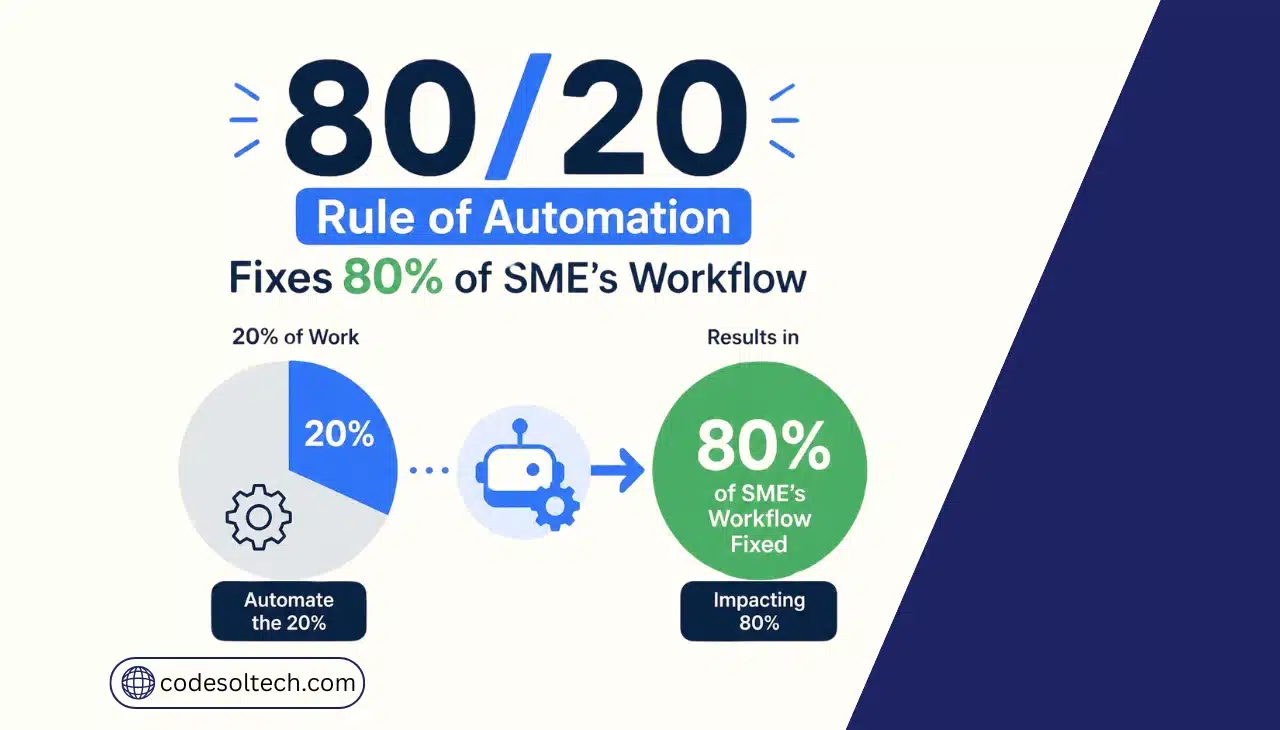
The 80/20 rule of workflow automation states that automating the 20% of tasks that are most repetitive, high-frequency, and rule-based eliminates roughly 80% of an SME’s manual workflow drag.
This 20% typically includes data entry, approvals, invoicing, and follow-up messages. Knowledge workers lose 60% of their week to this type of low-value “work about work,” according to Asana’s Anatomy of Work Index.
What Is the 80/20 Rule of Workflow Automation?
The 80/20 rule of workflow automation applies the Pareto Principle to business process design. Italian economist Vilfredo Pareto documented the underlying pattern in 1896, observing that 80% of Italy’s land belonged to 20% of the population.
Business analysts later applied the same ratio to labor: 20% of a company’s processes generate 80% of its wasted labor hours.
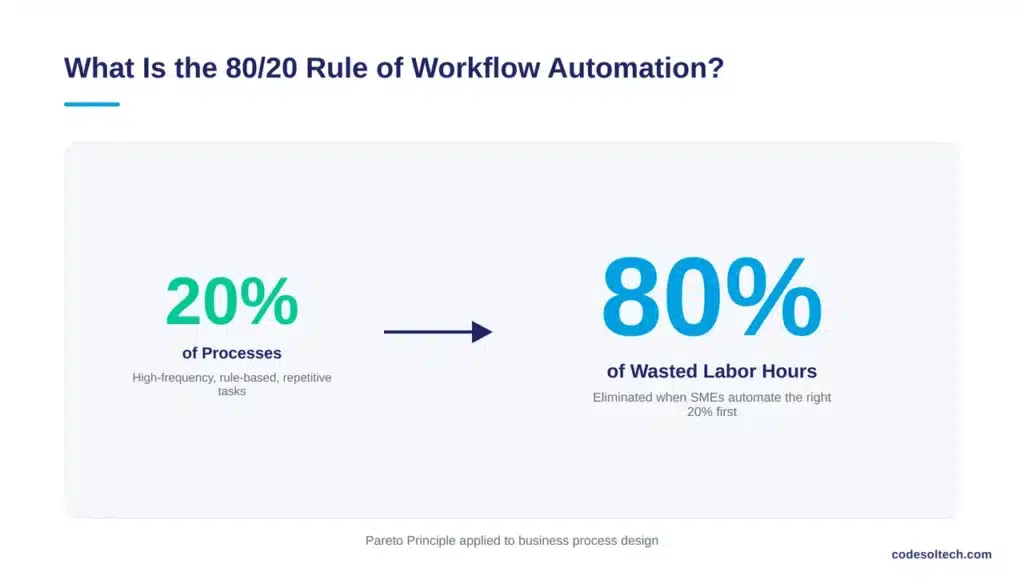
SMEs apply this rule by isolating high-frequency, low-complexity tasks first. Data entry, invoice matching, appointment confirmations, and status updates fit this category. These tasks follow fixed rules, repeat daily, and carry low decision complexity, which makes them ideal candidates for workflow automation software.
SMEs that automate this narrow task set free up time for revenue-generating work. Sales conversations, client relationships, and product development remain human-led. Automation removes the administrative layer sitting on top of that work, not the work itself.
The rule also sets a boundary on scope. It does not instruct SMEs to automate every process or purchase every available tool. It instructs SMEs to rank processes by impact and stop expanding automation once the highest-impact 20% is deployed and measured.
Which 20% of Tasks Deliver 80% of the Automation ROI?
The highest-ROI 20% consists of tasks that occur daily, follow a consistent sequence, and produce measurable errors when done manually. Six task categories meet these criteria in most SMEs:
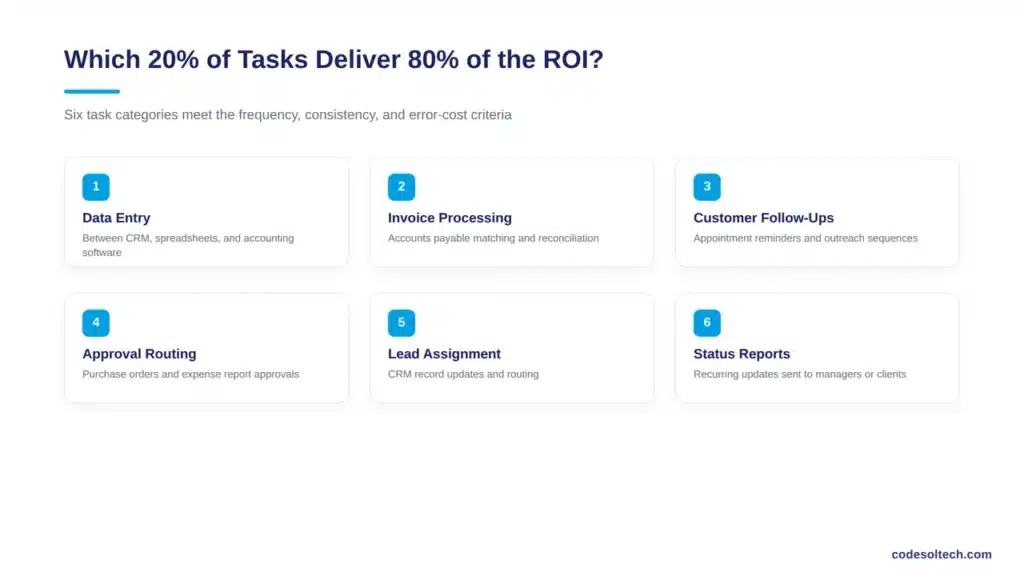
- Data entry between disconnected systems (CRM, spreadsheets, accounting software)
- Invoice processing and accounts payable matching
- Customer follow-up sequences and appointment reminders
- Approval routing for purchase orders and expense reports
- Lead assignment and CRM record updates
- Recurring status reports sent to managers or clients
Currently demonstrated technologies can automate 57% of US work hours today, according to McKinsey Global Institute’s 2025 research on AI and work.
This figure reflects technical capability, not adoption. SMEs that target the six categories above capture the majority of that technical potential without deploying enterprise-scale automation platforms.
McKinsey’s research also projects $2.9 trillion in annual US economic value by 2030 from automation adoption across agents and robots, provided organizations redesign workflows around the technology rather than automate individual tasks in isolation.
SMEs capture a proportional share of that value by redesigning the workflow around each automated task, not by bolting automation onto an unchanged process.
Task selection determines outcome. An SME that automates six high-frequency tasks recovers more time than an SME that automates one complex, low-frequency process, even if the second project costs more to build.
Frequency compounds weekly, so small time savings on daily tasks outperform large time savings on monthly ones.
How Do SMEs Identify Their High-Impact 20%?
SMEs identify high-impact tasks by scoring each recurring process on three variables: frequency, consistency, and error cost. A task that runs multiple times per day, follows the same steps each time, and incurs costly mistakes when handled manually ranks as a top automation candidate.
A task that runs monthly, changes shape each time, and carries low error cost ranks near the bottom, regardless of how tedious it feels to the employee performing it.
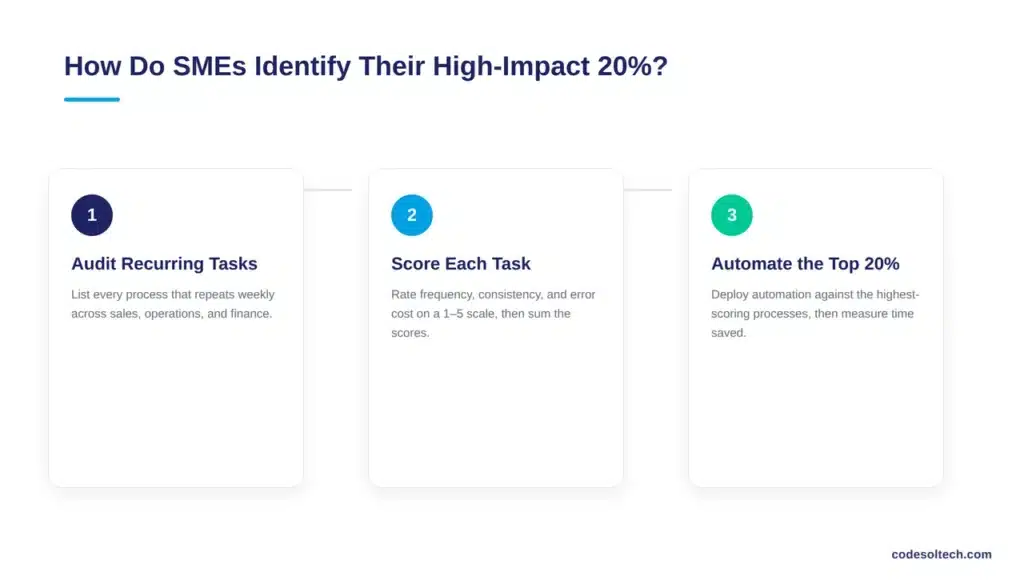
The scoring process runs in three steps:
- Audit recurring tasks. List every process that repeats weekly across sales, operations, and finance.
- Score each task. Rate frequency, consistency, and error cost on a 1–5 scale, then sum the scores.
- Automate the top-scoring 20%. Deploy automation tools against the highest-scoring processes first, then measure time saved before expanding.
Three tool categories cover most SME automation needs. Robotic process automation (RPA) handles rule-based data transfer between systems that lack native integrations. Integration platforms connect existing software, such as a CRM and an accounting tool, through prebuilt workflows.
Custom-built automation handles processes specific to one business, where off-the-shelf tools do not match the workflow.
SMEs measure results against a baseline, not an estimate. Recording the hours spent on a task for two weeks before automating it establishes the baseline. Comparing post-automation hours against that baseline confirms actual time saved, rather than a projected figure.
The table below maps each task category to its typical manual time cost and the automation solution that addresses it. SMEs use this as a starting reference, then adjust the time-cost figures against their own audit data.
| Task Category | Typical Manual Time Cost | Automation Solution |
|---|---|---|
| Data entry between systems | 3–5 hours/week per employee | CRM integration |
| Invoice and AP processing | 4–8 hours/week per finance staff member | ERP integration |
| Customer follow-ups | 2–4 hours/week per sales rep | Chatbot integration |
| Order and payment reconciliation | 3–6 hours/week per operations staff member | Payment gateway integration |
| Fulfillment status updates | 2–5 hours/week per warehouse coordinator | Fulfillment automation |
Why Does Automating the Wrong 80% Waste Budget?
SMEs waste automation budget when they build tools for low-frequency, high-complexity tasks first. A process that runs twice a month and requires judgment calls delivers a poor return, regardless of how well the automation is built.
This mistake diverts development hours from the daily, rule-based tasks that yield the greatest time savings.
Knowledge workers spend 60% of their working day on “work about work,” which includes status updates, duplicated data entry, and coordination tasks rather than skilled output, according to Asana’s Anatomy of Work Index.
This 60% overlaps heavily with the automatable 20% described above. Targeting it first produces the fastest measurable ROI.
Budget allocation follows the same logic as task selection. An SME with a fixed automation budget generates more return by funding five small, high-frequency automations than one large, low-frequency automation.
Each of the five compounds weekly, while the single large project delivers value only when it runs, which for low-frequency tasks may be once or twice a month.
What Mistakes Do SMEs Make When Applying the 80/20 Rule?
Four mistakes account for most failed automation projects at SMEs:
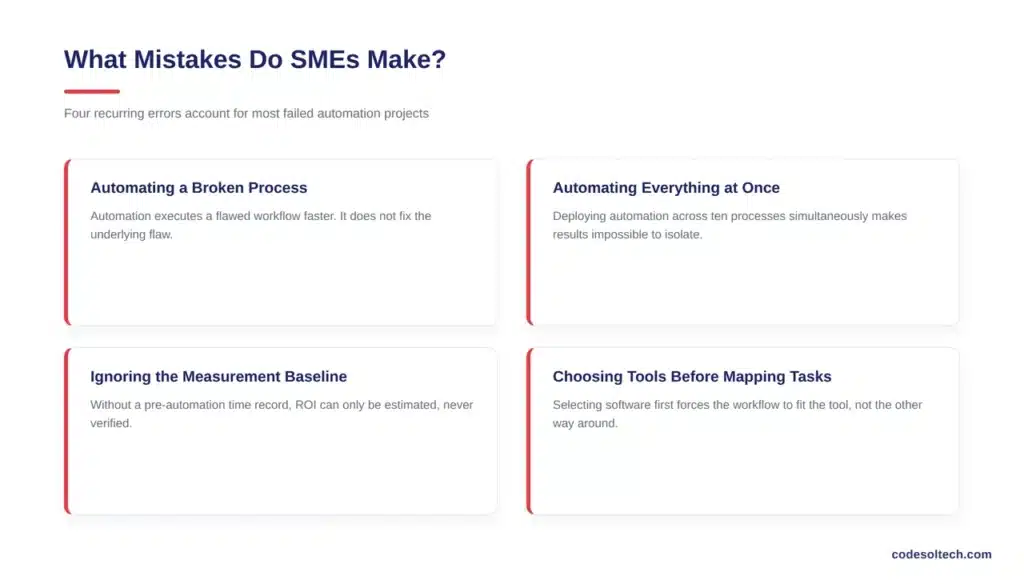
- Automating a broken process. Automation executes a flawed workflow faster; it does not fix the flaw. SMEs that skip the audit step often automate errors at scale.
- Automating everything at once. Deploying automation across ten processes simultaneously makes it impossible to isolate which change produced which result.
- Ignoring the measurement baseline. Without a pre-automation time record, SMEs cannot verify ROI, only estimate it.
- Choosing tools before mapping tasks. Selecting software first forces the workflow to fit the tool, rather than selecting a tool that fits the highest-priority task.
SMEs that sequence the framework correctly, audit first, score second, automate third, avoid all four mistakes by design rather than by correction after deployment.
What Are Real Examples of the 80/20 Rule in Action?
SMEs apply the 80/20 rule across ecommerce, services, and B2B operations. Four implementation patterns recur across industries:
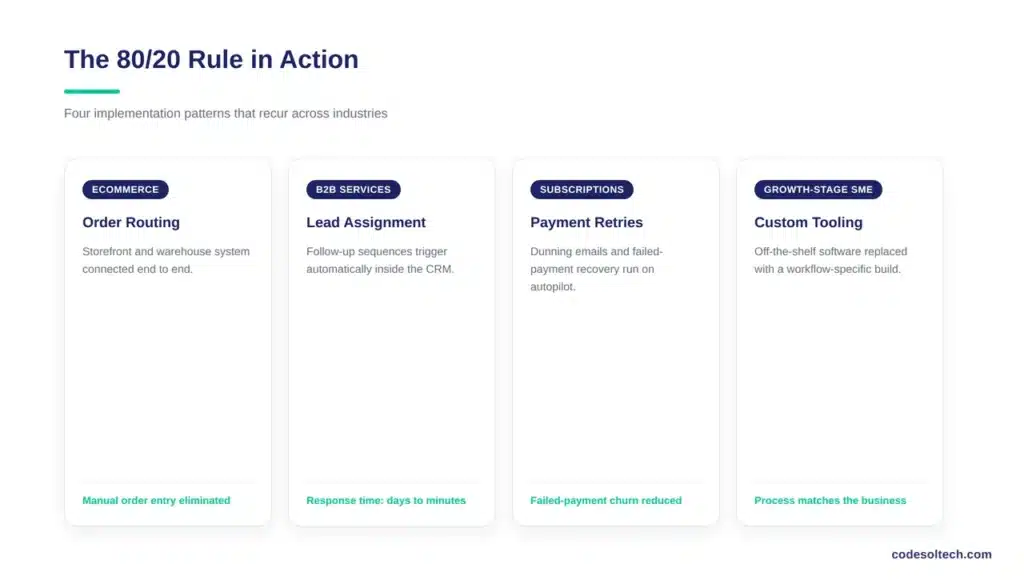
- An ecommerce SME automates order routing between its storefront and warehouse system, removing manual order entry entirely through fulfillment automation.
- A B2B services firm automates lead assignment and follow-up sequences through CRM integration, cutting response time from days to minutes.
- A subscription business automates payment retries and dunning emails through payment gateway integration, reducing failed-payment churn.
- A growing SME replaces manual internal tooling with a custom software development project once off-the-shelf tools no longer fit its workflow.
Each example targets a task that is frequent, consistent, and costly when handled manually, which is the exact definition of the automatable 20%.
Does the 80/20 Rule Apply the Same Way to Every SME?
No. The specific tasks inside the automatable 20% shift by industry, but the selection criteria stay constant. An ecommerce SME’s top 20% centers on order and fulfillment data. A professional services SME’s top 20% centers on scheduling, invoicing, and client communication.
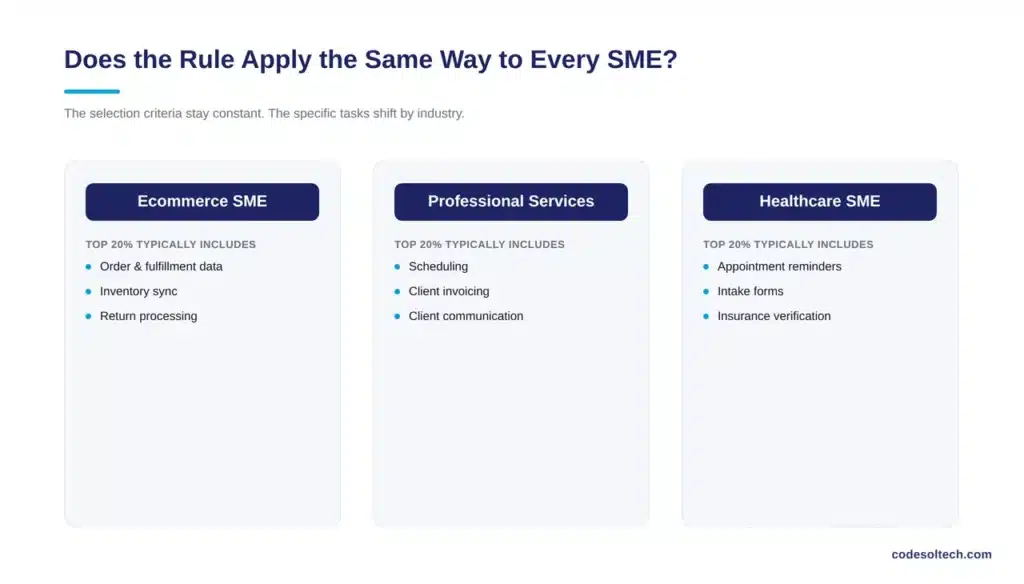
A healthcare SME’s top 20% centers on appointment reminders and intake forms.
SMEs identify their own top 20% by applying the frequency, consistency, and error-cost framework to their specific task list rather than copying another company’s automation stack.
A restaurant’s automatable 20% looks nothing like a law firm’s, even though both follow the same underlying rule.
Company size shifts the calculation further. A 10-person SME may find its entire automatable 20% inside one department, such as finance.
A 100-person SME typically finds its automatable 20% spread across three or four departments, since task volume and system fragmentation both increase with headcount.
Final Words
The 80/20 rule of workflow automation gives SMEs a filter, not a mandate to automate everything. Score tasks by frequency, consistency, and error cost, then automate the top 20% first. This sequence delivers the fastest ROI, the lowest implementation risk, and the clearest path to reclaiming the 60% of the workweek lost to manual coordination.
Ready to identify your SME’s automatable 20%?
Codesoltech builds custom workflow automation systems for growing businesses.