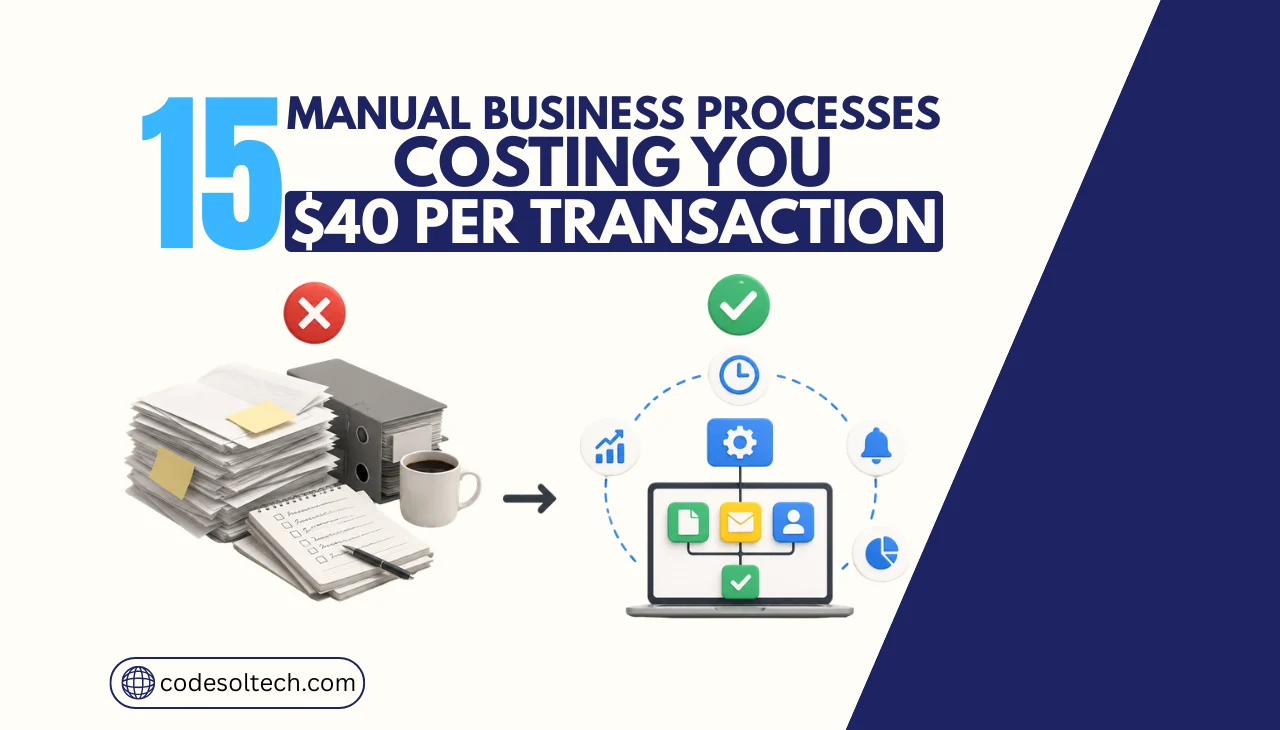
Manual business processes cost companies $15 to $40 in labor per single transaction, compared to $2 to $5 with automation. Invoicing, onboarding, inventory updates, and data entry across disconnected systems are the most common manual tasks still handled via spreadsheets and email.
Automating these 15 processes cuts errors, reduces payroll hours, and frees staff for revenue-generating work.
What Counts as a “Manual Business Process,” and Why Does It Cost More Than You Think?
A manual business process is any repeatable business task that a human executes by hand instead of a system executing it through pre-set rules. Copying data from one spreadsheet to another, typing invoice numbers into accounting software, and manually approving expense reports are all manual processes.
Manual processes cost more than automated ones for three measurable reasons: labor hours, error correction, and delayed cash flow.
McKinsey Global Institute analyzed roughly 2,000 individual work activities across the US labor market and found that at least one-third of the tasks in about 60% of occupations could be automated with technology that already exists. That is not a forecast. It is a description of current technical capability sitting unused inside most companies.
Three cost signals indicate a process needs automation now, not later:
- The task repeats more than 10 times per week across the team
- The task involves copying data between two or more separate systems
- The task creates a delay that a customer or vendor can feel (late invoice, slow response, missed order update)
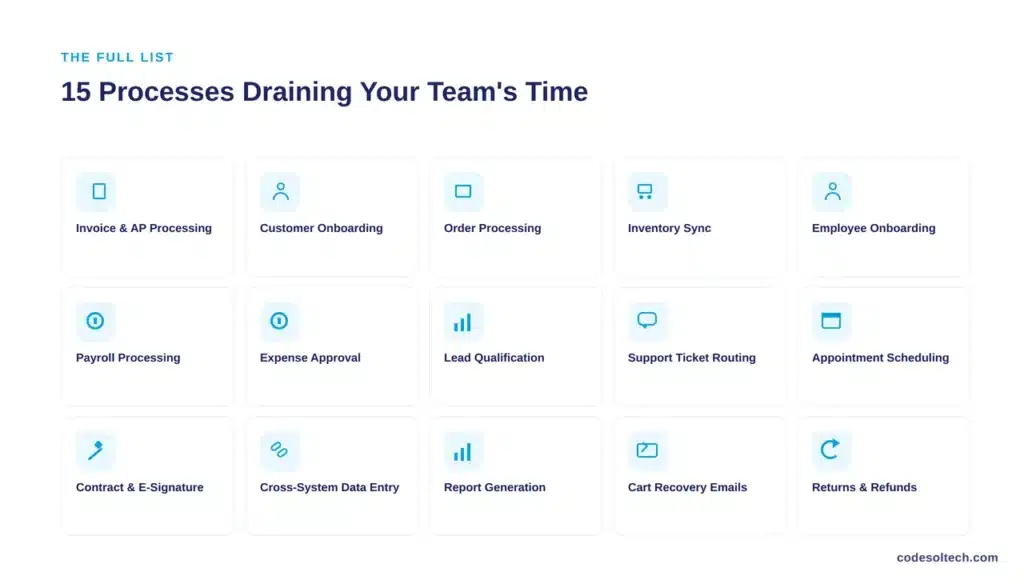
15 Business Processes Draining Your Team’s Time
Each process below shares the same pattern: a rule-based, repetitive task currently executed by a person that a workflow engine, API integration, or RPA bot can execute instead. Codesoltech maps every one of these to a specific automation architecture during a process audit.
1. Invoice and Accounts Payable Processing
Manual invoice processing costs $15 to $40 per invoice in labor, matching, and error correction, according to multiple accounts payable benchmarking studies.
Automated accounts payable workflows extract invoice data with OCR, match purchase orders automatically, and route approvals without a human retyping a single line item.
Companies processing more than 500 invoices a month recover the automation investment within one billing cycle.
2. Customer Onboarding
Manual onboarding requires a staff member to collect documents, verify identity, create accounts, and send welcome emails across separate tools. Automated onboarding triggers a single workflow that creates the account, sends verification links, and populates the CRM record simultaneously.
This reduces onboarding time from days to minutes for ecommerce and SaaS platforms.
3. Order Processing and Fulfillment
Manually re-entering order data from a storefront into a warehouse management system or ERP introduces the exact error rate documented in accounts payable studies.
Fulfillment automation connects the storefront, inventory system, and shipping carrier through APIs, so an order triggers pick, pack, and label generation without manual intervention.
4. Inventory and Stock Level Updates Across Channels
Retailers selling on three or more channels (own store, Amazon, marketplaces) manually update stock counts to prevent overselling.
A synced inventory system pushes real-time stock changes to every channel from one source of truth, eliminating the spreadsheet reconciliation that manual multichannel sellers perform daily.
5. Employee Onboarding and HR Paperwork
HR teams manually collect tax forms, set up payroll records, and provision software accounts for new hires. Automated HR onboarding workflows trigger account provisioning, e-signature requests, and IT ticket creation from a single new-hire record, removing the multi-department email chain.
6. Payroll Processing
Manual payroll requires collecting timesheets, calculating deductions, and cross-checking compliance rules by hand, a process especially error-prone across multiple countries or states.
Automated payroll systems pull time data directly from time-tracking tools and apply tax rules automatically, cutting the manual reconciliation step entirely.
7. Expense Report Approval
Employees manually submit receipts, managers manually review line items, and finance manually re-enters approved expenses into accounting software. An automated expense workflow captures receipts via mobile upload, applies approval rules automatically, and posts directly to the general ledger.
8. Lead Qualification and CRM Data Entry
Sales reps manually score leads and copy contact details from web forms into a CRM system. Automated lead routing scores leads against defined criteria the moment a form submits and creates the CRM record instantly, so reps spend time selling instead of typing.
9. Customer Support Ticket Routing
Support agents manually read incoming tickets and forward them to the correct department. A rules-based or chatbot-assisted routing system classifies tickets by keyword and urgency, then assigns them automatically, cutting first-response time significantly.
10. Appointment and Meeting Scheduling
Manually scheduling meetings by email requires multiple back-and-forth messages to find a shared time slot. Scheduling automation tools sync calendars and let external parties book directly into available slots, removing the email chain entirely.
11. Contract Creation and E-Signature Routing
Legal and sales teams manually draft contracts from templates and physically track signature status by email. Automated contract workflows generate documents from approved templates and route them for e-signature with automatic status tracking, reducing contract turnaround time.
12. Data Entry Between Disconnected Systems
Businesses running separate tools for ecommerce, accounting, and inventory frequently pay staff to manually copy data between systems because the tools do not natively communicate. API-based system integration eliminates duplicate entry entirely by syncing records automatically between platforms in real time.
13. Report Generation and Dashboarding
Managers manually export data from multiple tools into spreadsheets to build weekly or monthly reports. Automated dashboards pull data directly from source systems and refresh on a schedule, eliminating the manual export-and-format cycle.
14. Email Follow-Ups and Abandoned Cart Recovery
Ecommerce teams manually track which customers abandoned a cart and send follow-up emails individually. Automated abandoned cart workflows trigger timed follow-up sequences the moment a cart is abandoned, recovering revenue without staff involvement.
15. Returns and Refund Processing
Manually processing a return requires a staff member to verify eligibility, issue a refund through the payment gateway, and update inventory by hand.
Automated returns workflows apply eligibility rules automatically, trigger the refund through the payment gateway API, and restock inventory in one connected process.
How Much Can Automating These Processes Actually Save?
Automation savings scale with transaction volume and employee headcount, but the pattern holds across company sizes. A 2024 Forrester Total Economic Impact study, commissioned by Microsoft, measured a composite organization deploying workflow automation across accounts payable, data entry, and reporting tasks.
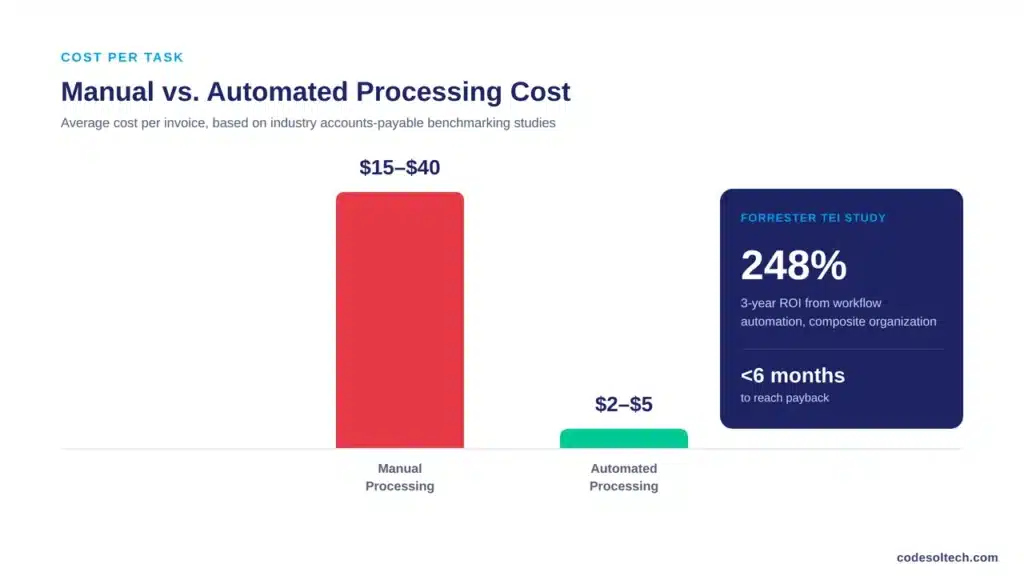
The study found a 248% return on investment over three years, with the investment paying for itself in under six months. Employees involved in high-impact automation use cases recovered roughly 200 hours of work per year.
Market demand confirms this shift is not theoretical. Grand View Research values the global robotic process automation market at $4.68 billion in 2025 and projects it to reach $35.84 billion by 2033, a compound annual growth rate of 29%. That growth is driven by companies replacing exactly the 15 manual processes listed above.
| Process Category | Manual Cost Range | Automated Cost Range |
|---|---|---|
| Invoice / AP processing | $15-$40 per invoice | $2-$5 per invoice |
| RPA-eligible task automation (Forrester TEI composite) | 200 hours/employee/year lost | 200 hours/employee/year recovered |
| Data entry error correction | ~1% error rate, $53 per error | Under 0.1% error rate with validation |
Which Process Should You Automate First?
Automate the process with the highest transaction volume and the highest error cost first, not the process that feels most annoying. Rank each manual process on two variables: how many times per week it repeats, and how many systems it touches.
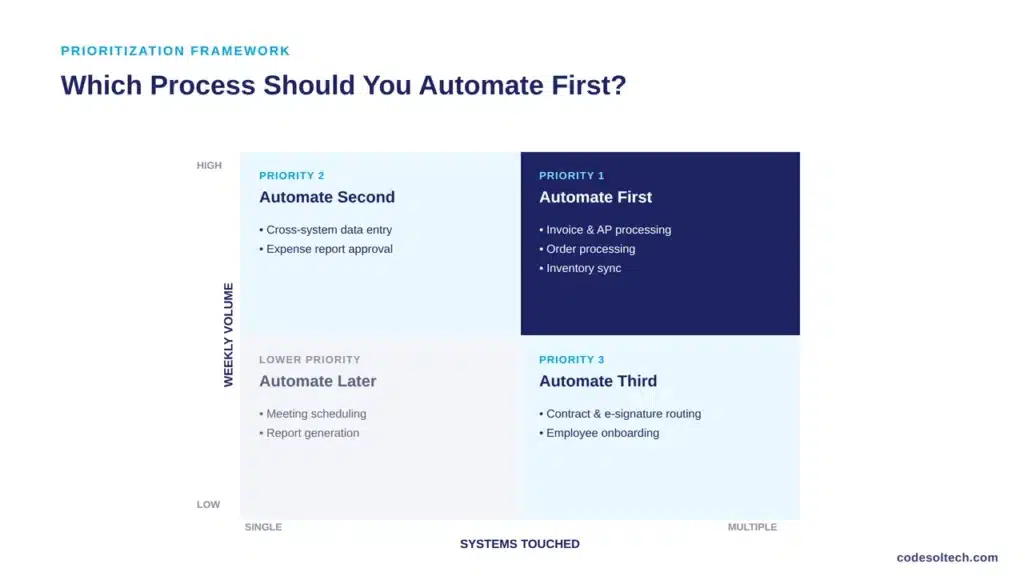
A process that repeats daily and touches three or more disconnected systems, such as order processing or invoicing, produces the fastest measurable return.
- High volume + multiple systems = automate first (invoicing, order processing, inventory sync)
- High volume + single system = automate second (data entry, expense reports)
- Low volume + high error cost = automate third (contract routing, HR onboarding)
Final Words
Fifteen processes, one root cause: humans doing work that rules-based systems can execute faster and more cheaply. Manual work does not scale with growth; it multiplies errors and payroll cost alongside it.
Start with the one process costing the most in labor hours or error correction, automate it, then move to the next. The businesses winning right now already made this switch.
Ready to find out which of your processes cost the most to leave manual?
Request a free process audit from Codesoltech and get a prioritized automation roadmap built for your exact tech stack.