If you’ve spent more than ten minutes Googling “best ecommerce platform,” you already know these two names come up constantly. And for good reason. Shopify and WooCommerce together power over 11 million online stores globally that’s not a small pond you’re jumping into.
But here’s the thing: choosing the wrong one doesn’t just cost you time. It can cost you months of painful migration work and thousands in developer fees to undo. So let’s settle this properly with real data, no fluff, and maybe a little humor along the way.
What Are These Platforms, Actually?
Before we get into the numbers, let’s make sure we’re on the same page.
Shopify is a fully hosted, all-in-one ecommerce platform. You sign up, pay a monthly fee, and Shopify handles everything: hosting, security, updates, and server maintenance. Think of it as renting a fully furnished apartment. Everything works. You just moved in.
WooCommerce is a free, open-source plugin built on top of WordPress. You own the code, choose your own hosting, and manage the full stack yourself.
It’s more like buying a plot of land and building your own house. Total freedom but you’re also responsible for the plumbing.
Market Share: Who’s Actually Winning?
Here’s where it gets interesting.
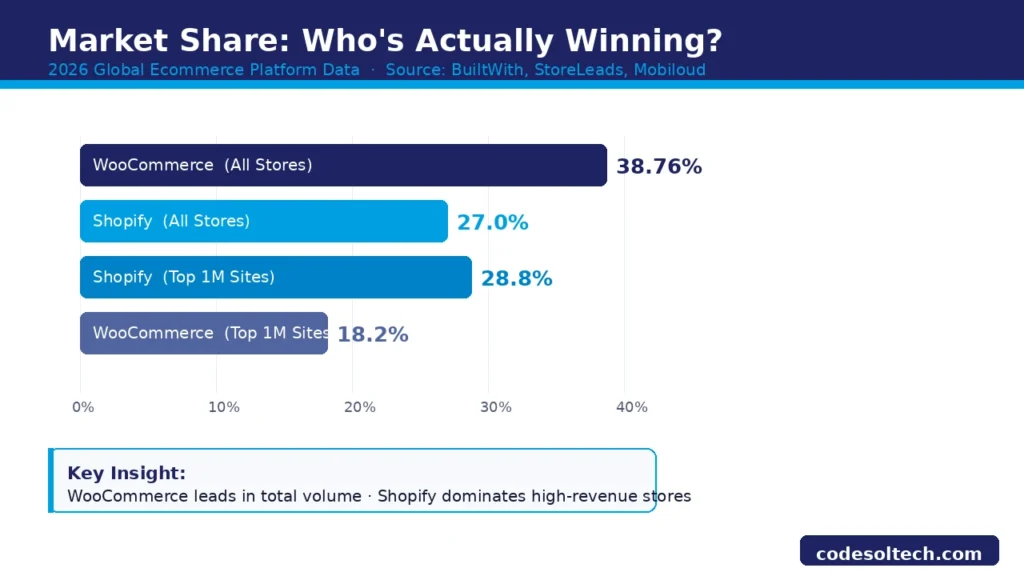
WooCommerce holds 38.76% of the global ecommerce platform market, while Shopify commands around 27%. On paper, WooCommerce looks like the winner. But raw numbers can be misleading.
Among high-traffic sites, Shopify actually leads with 28.8% of the top 1 million ecommerce websites, compared to WooCommerce’s 18.2%.
In other words, WooCommerce dominates in volume (lots of small and medium stores), while Shopify punches harder at the premium, high-revenue end of the market.
Neither platform is “winning” in an absolute sense. They’ve carved out different segments of a massive, growing market.
According to data from BuiltWith and StoreLeads, Shopify’s GMV reached $292 billion in 2024 and is on pace to exceed $350 billion in 2025. Those are numbers that command serious respect.
Pricing: Which One Actually Costs More?
This is where most comparisons go wrong. People look at WooCommerce, see the word “free,” and think they’ve found a deal. They haven’t — not always.
WooCommerce’s core plugin is free and open-source, but running a store requires paid hosting ($10–$120/month), a domain ($12–$20/year), and typically $500–$2,000/year in premium extensions.
The total cost for a functional WooCommerce store starts at approximately $800/year for a basic setup and scales to $5,000–$15,000/year for a feature-rich mid-market store.
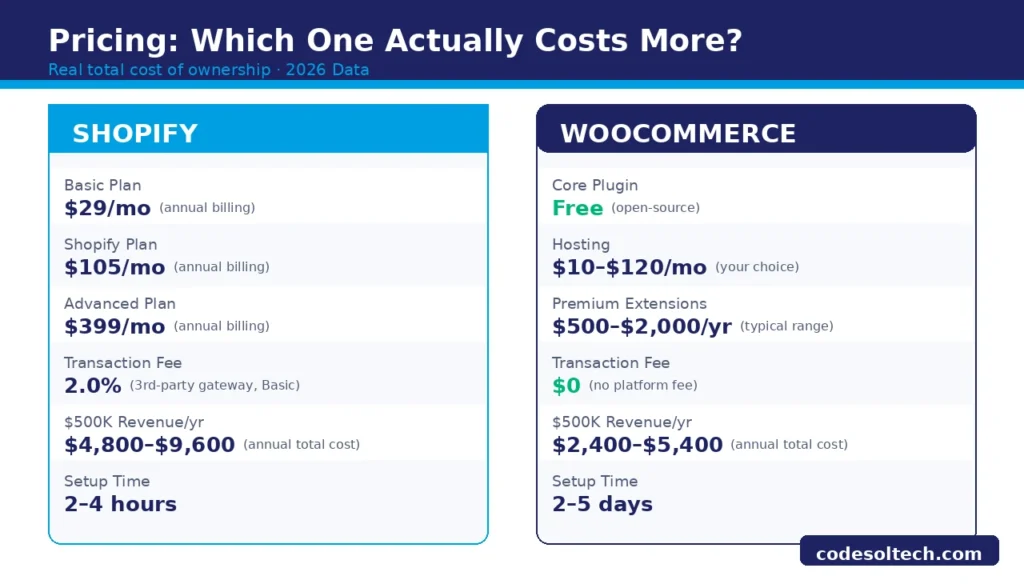
Shopify, on the other hand, keeps things more predictable. Shopify’s plans range from $29 to $299 per month, with hosting, security, and updates all baked in.
Now here’s the real kicker: a store doing $500K in annual revenue pays roughly $4,800–$9,600 per year on Shopify versus $2,400–$5,400 on WooCommerce.
WooCommerce is cheaper if you have the technical skills to manage it. If you don’t, expect to pay a developer. That changes the math fast.
And watch out for Shopify’s transaction fees. On Shopify Basic with a third-party gateway, a 2.0% extra fee equals $20,000/year in pure platform charges on a $1M revenue store. On Shopify Advanced, that drops to $5,000/year. WooCommerce charges $0.
Bottom line on pricing: WooCommerce can be cheaper at scale, but it requires technical investment. Shopify is more predictable and often the safer bet for non-technical founders.
Ease of Use: Setup, Speed, and Sanity
Let’s be honest most business owners don’t want to think about server configurations at 2am during a product launch.
A new Shopify store can go from signup to live in 2–4 hours. The setup wizard guides you through adding products, choosing a theme, configuring shipping, and connecting payments. No technical knowledge is required.
WooCommerce? A different story. A WooCommerce store launch typically takes 2–5 days for someone with WordPress experience, or 1–3 weeks for a complete beginner.
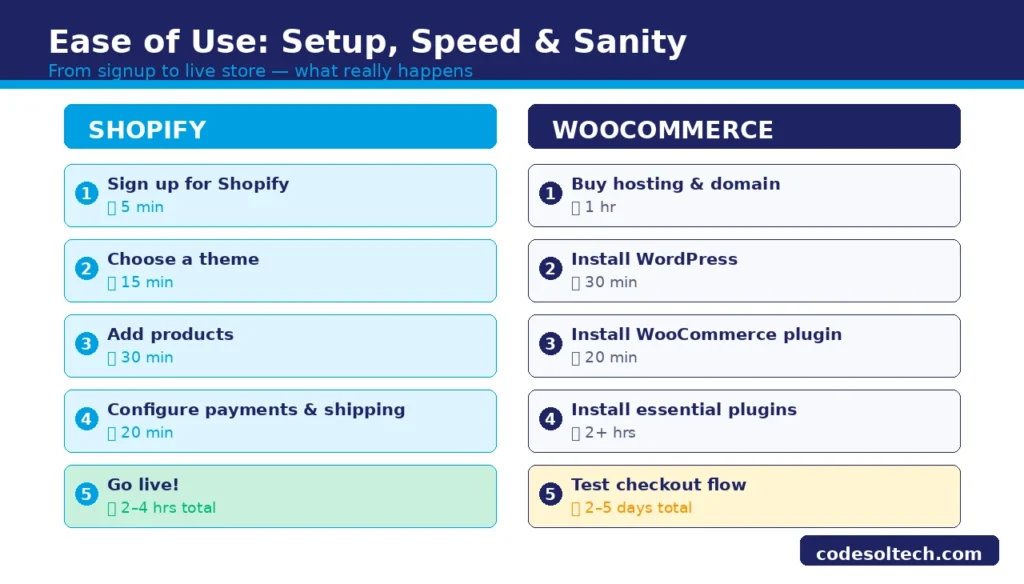
Steps include selecting and configuring hosting, installing WordPress, installing WooCommerce, choosing and customizing a theme, installing essential plugins, and testing the entire checkout flow.
That’s not a knock on WooCommerce. It’s just reality. If you enjoy that process, WooCommerce gives you incredible control. If you’d rather spend that time on marketing and products, Shopify gets you there faster.
Performance and Speed: Does Platform Choice Matter?
Yes, it really does. Google’s own research confirms that every 100ms improvement in page load correlates with better conversion rates. So this is not a nerdy metric it’s a revenue metric.
Shopify leads with the highest Core Web Vitals pass rate (58% of origins) thanks to its managed infrastructure and global CDN.
Shopify runs on Cloudflare’s network, serving content from over 300 edge locations worldwide. Shopify delivers a median Largest Contentful Paint (LCP) of 2.1 seconds on mobile and 1.4 seconds on desktop.
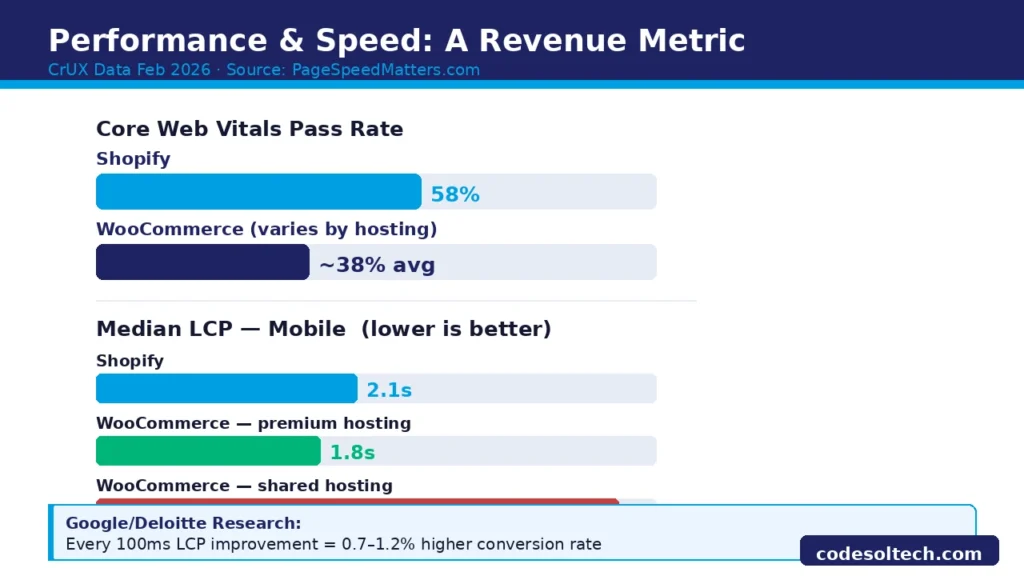
WooCommerce performance varies wildly based on your hosting choice. An unoptimized WooCommerce store on shared hosting typically scores 25–40 on Google PageSpeed mobile, with LCP exceeding 4 seconds.
However, on premium managed hosting like Kinsta or Cloudways, WooCommerce can actually beat Shopify’s raw speed numbers.
The key takeaway: Shopify gives you a strong floor. WooCommerce gives you a higher ceiling — if you invest in the right infrastructure.
SEO: Who Ranks Better on Google?
This one genuinely matters for ecommerce businesses that rely on organic traffic.
WooCommerce has a structural SEO advantage due to WordPress’s mature blogging engine, flexible URL structures, and plugins like Yoast SEO and Rank Math.
Stores that rely on content marketing for organic traffic will find WooCommerce 3–5x more capable for content management.
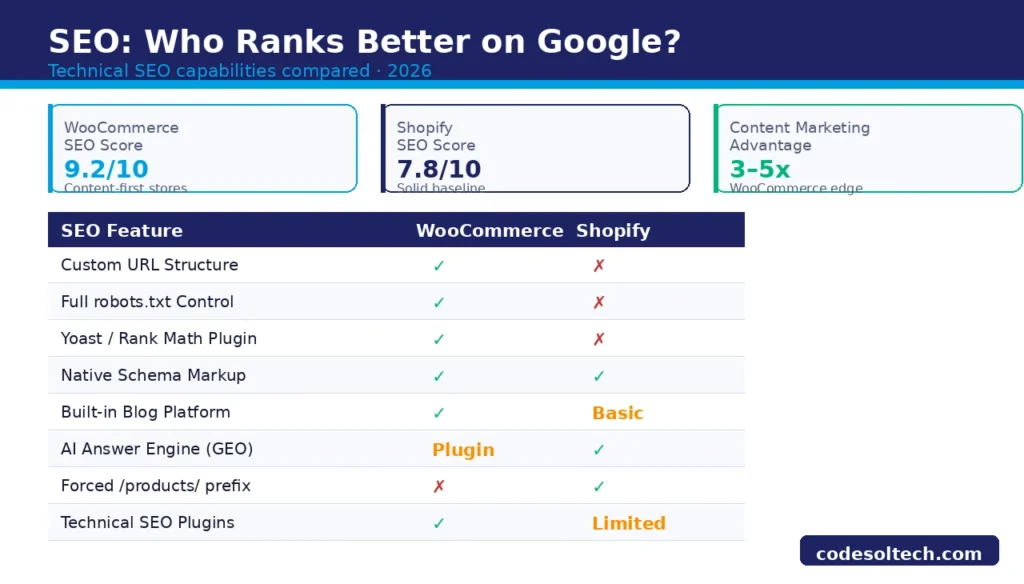
WooCommerce gives you full control clean URL structures, robots.txt access, granular schema markup, and a proper blogging platform built for content-driven SEO.
Shopify has improved significantly. Shopify has improved its SEO tools in 2026 with native schema markup and better meta tag control, but its rigid URL structures and basic blog functionality remain limitations.
You can’t remove the mandatory “/products/” or “/collections/” prefixes from URLs, which frustrates technical SEO practitioners.
That said, for most stores, the SEO difference between Shopify and WooCommerce is negligible. Content quality, backlink profile, and user experience matter far more than marginal technical SEO differences.
If blogging and content are your primary traffic engine, WooCommerce wins this round. For everything else, both platforms perform comparably.
AI Features: The 2026 Wildcard
This is the section most 2024 comparisons missed entirely and in 2026, it matters more than ever.
Shopify’s AI features are now part of the platform’s native core offering. The Shopify Sidekick AI assistant handles store configuration questions, analytics queries, and basic troubleshooting directly in the admin panel.
It also includes AI-generated product descriptions, automated email copy, AI-powered image backgrounds, and smart inventory forecasting all included at no extra cost.
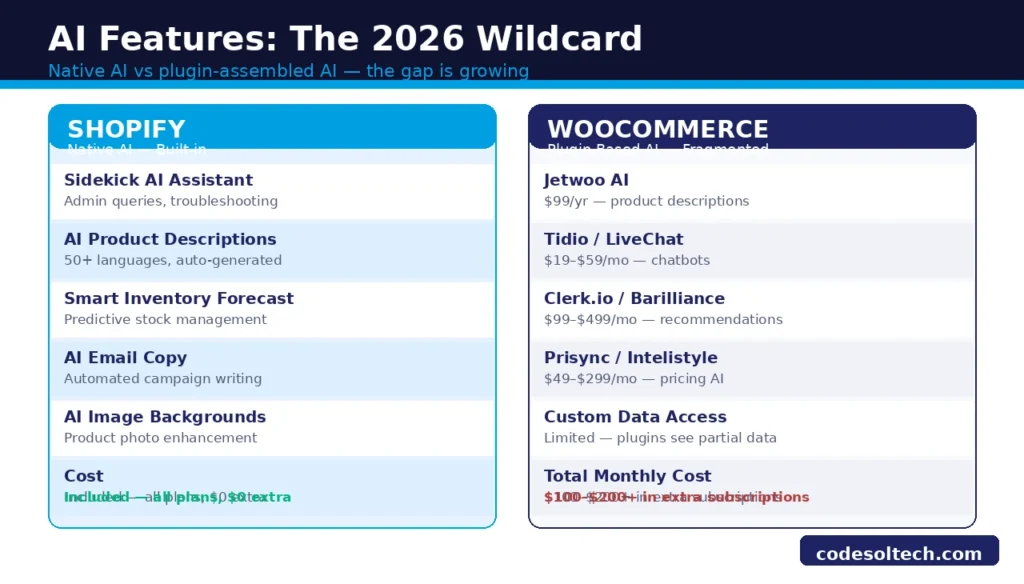
WooCommerce offers AI capabilities through plugins, but the experience is fragmented. WooCommerce’s AI ecosystem works, but it’s fragmented, manual, and subscription-dependent.
There is a structural difference: Shopify’s AI has native access to your full store data, order history, and commerce context. A WooCommerce plugin does not have that by default.
If you want AI deeply baked into your store operations without managing five separate subscriptions, Shopify has the clear edge here in 2026.
Point of Sale (POS): An Important 2026 Update
Here’s a detail that caught many store owners off guard this year. In February 2026, WooCommerce discontinued its own native POS. If you sell in person, you now need a third-party app such as Lightspeed via Kestrel, which costs $249 per year.
Meanwhile, Shopify POS version 11.0 was released in March 2026, improving customer flows, checkout speed, and post-purchase options. If in-person selling is part of your business model, this is no longer an even comparison.
Which Platform Should You Choose?
Here’s the honest verdict there’s no universal winner. But there are clear patterns.
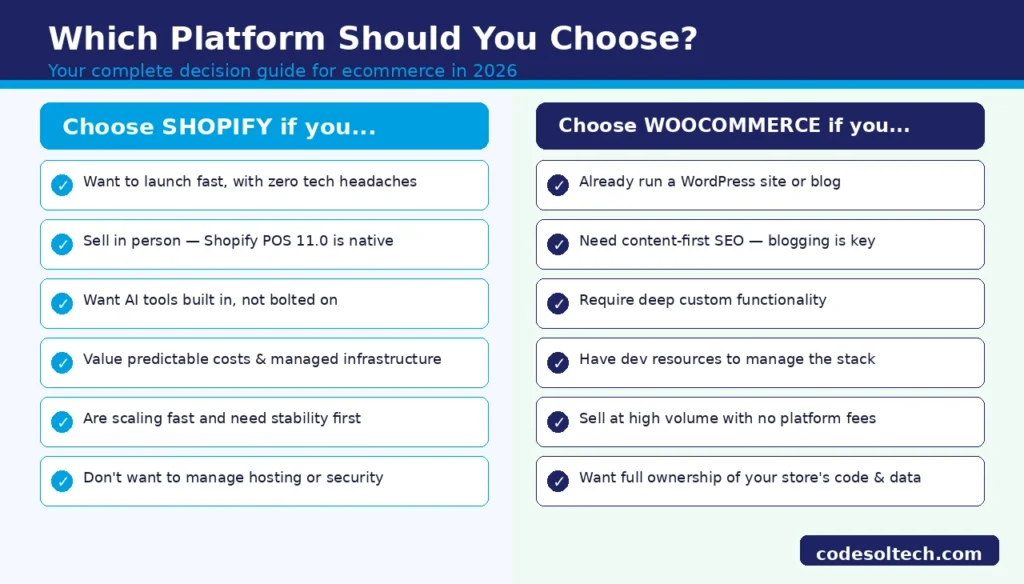
Choose Shopify if you:
- Are launching your first store and want speed without technical headaches
- Sell in person and need a reliable, native POS
- Want AI tools built into your store without extra subscriptions
- Value predictable costs and 24/7 managed infrastructure
- Are scaling fast and need stability over customization
Choose WooCommerce if you:
- Already use WordPress and want to keep everything in one ecosystem
- Run a content-heavy site where blogging drives most of your traffic
- Need deep technical customization that Shopify’s architecture can’t accommodate
- Have developer resources or are willing to invest in technical maintenance
- Are selling at high volume and want to eliminate platform transaction fees
In 2026, the debate between Shopify and WooCommerce has evolved from a simple feature-by-feature comparison into a fundamental choice of business philosophy, whether your brand should operate as a technology company or a product innovator.
That’s a sharp way to put it. Shopify lets you focus on the product. WooCommerce gives you the tools to build the technology.
Final Thoughts
Both platforms are mature, battle-tested, and capable of running multi-million dollar stores. The wrong question is “which platform is better?” The right question is “Which platform is better for you?”
If you’re a solo founder who just wants to sell and grow, start with Shopify. If you’re a developer, agency, or content-first brand that wants total control, WooCommerce will reward your investment.
The good news? Neither decision is permanent. Migration tools exist. Stores move between platforms every day. But getting the right foundation from the start saves you a lot of headaches down the road.
Pick the one that fits where you are now, not just where you hope to be.
Want to start your Ecommerce business? Let’s talk to our Expert for a free consultation.
![Fixing CRM Contact Deduplication [Causes & Fixes Guide]](https://www.codesoltech.com/wp-content/uploads/2026/09/Fixing-CRM-Contact-Deduplication-Causes-Fixes-Guide.webp)